Why St Peter’s Basilica Took More Than a Century to Build
Behind St Peter’s Basilica lies a story of an apostle’s witness, extraordinary art, costly mistakes and generations of patient work.
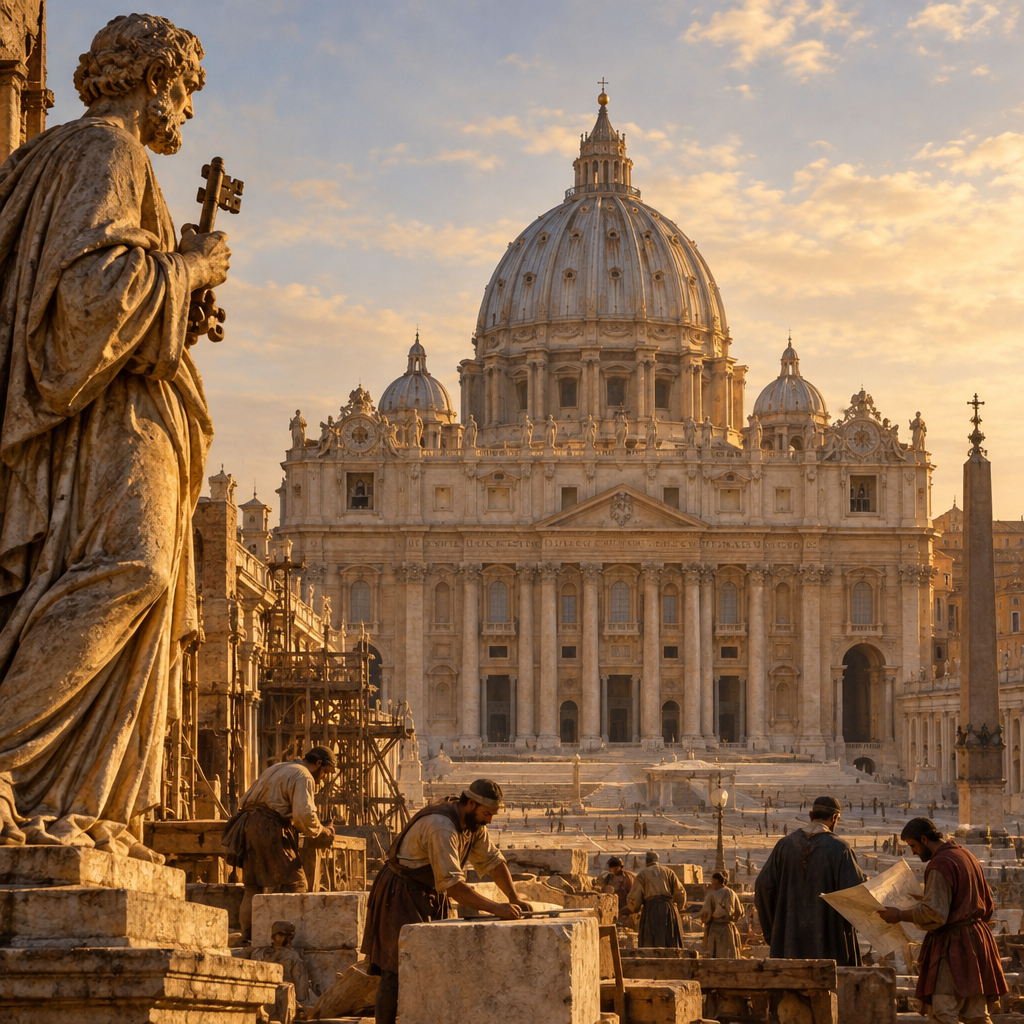
A church can take longer to build than any of its builders will live. St Peter’s Basilica in Rome is one extraordinary example: its foundation stone was laid in 1506, but it was not dedicated until 1626.
For readers on Monday, 19 October 2026, its story offers more than a glimpse of magnificent architecture. It invites us to consider how Christians have tried—sometimes beautifully, sometimes imperfectly—to give visible expression to their faith.
Before the dome, there was a grave
The story begins not with marble, but with the apostle Peter.
Catholic tradition holds that Peter suffered martyrdom in Rome under the emperor Nero and was buried near the Vatican Hill. Christians revered the site long before the present basilica existed.
In the fourth century, the emperor Constantine sponsored a great church over the place honoured as Peter’s tomb. Building there required considerable engineering: the hillside had to be reshaped, and parts of an existing burial ground were covered.
The location mattered more than convenience. This church would connect generations of Christians with the memory of an apostle who had known Jesus, failed him, received his mercy and returned to serve.
Excavations beneath the present basilica in the twentieth century uncovered an ancient cemetery and evidence of early veneration at the site traditionally associated with Peter’s burial. The interpretation of particular remains requires care; archaeology and the Church’s longstanding tradition are related, but they are not identical kinds of evidence.
Why replace an ancient basilica?
Constantine’s church stood for more than a thousand years. It witnessed worship, pilgrimages, papal ceremonies and the coronation of Charlemagne as emperor in 800.
By the fifteenth century, however, the building had serious structural problems. Plans for repair and rebuilding developed under successive popes.
Pope Julius II eventually chose a far more ambitious course: a new basilica. On 18 April 1506, he laid its foundation stone.
The decision was momentous. The old church was not merely worn masonry; it held centuries of Christian memory. Its gradual demolition caused real concern, reminding us that debates about preserving beloved churches are nothing new.
A building shaped by many hands
Donato Bramante’s early design imagined a monumental church arranged around a central dome. After his death, other architects revised the plans. The project passed through different hands, changing priorities and enormous practical difficulties.
Michelangelo became its chief architect in 1546, already in his seventies. He simplified earlier schemes and gave the dome its defining architectural conception, although he died before it was completed. Giacomo della Porta, working with Domenico Fontana, later brought the dome to completion, modifying its profile.
In the early seventeenth century, Carlo Maderno extended the nave and designed the façade. Pope Urban VIII dedicated the new basilica on 18 November 1626.
Even then, work continued. Gian Lorenzo Bernini’s great bronze canopy above the papal altar and his sweeping colonnades outside helped create the appearance visitors recognise today.
St Peter’s was not the achievement of one inspired individual. It emerged through generations of labour, artistic judgement and revision.
Beauty, money and a painful lesson
The story also has a difficult chapter. An indulgence campaign connected with financing the rebuilding became entangled in the controversy that helped ignite the Protestant Reformation in 1517.
Catholic teaching does not understand an indulgence as buying forgiveness. Forgiveness of sins cannot be purchased. Nevertheless, abuses and misleading preaching surrounding indulgences caused grave scandal.
A faithful account should neither dismiss the basilica’s beauty nor hide the harm associated with its history. Sacred purposes do not excuse corrupt methods. The Church continually needs conversion, honesty and reform.
Not Rome’s cathedral
Despite its worldwide prominence, St Peter’s is not the cathedral of Rome. That distinction belongs to the Archbasilica of St John Lateran, which contains the bishop of Rome’s official chair.
St Peter’s has a different, deeply significant place: a basilica built around the memory of Peter’s witness and closely associated with the ministry of his successors.
Its deepest meaning is not that Christians can build impressively. It is that faith is received, lived and handed on—often through work whose completion we will never see.
We need not build a dome to take part. A faithful prayer, an honest act of repentance and a quiet work of mercy can also become gifts to those who come after us.