Walsingham, England’s Nazareth: History and a Pilgrim’s Guide
Discover Walsingham’s sacred history, its Catholic and Anglican shrines, and practical advice for a peaceful pilgrimage to Norfolk.
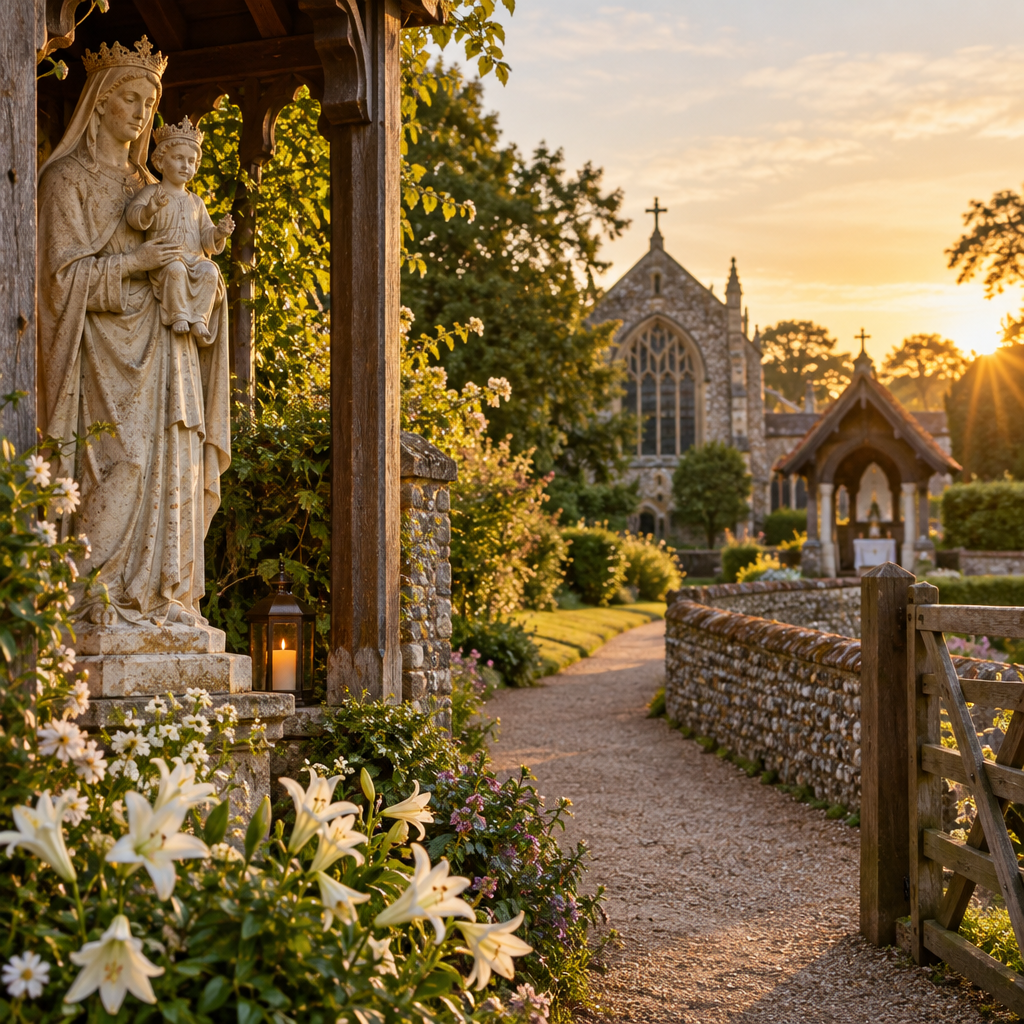
In a quiet corner of north Norfolk, Walsingham has welcomed pilgrims for centuries. Its lanes, shrines and countryside invite a slower pace: time to pray, to listen, and to bring the needs of those we love before God.
Known as “England’s Nazareth”, Walsingham draws our attention to the home where Mary welcomed God’s call. A pilgrimage here is not simply a journey into England’s religious past. It is an invitation to make room for Christ in ordinary life.
The story of England’s Nazareth
Tradition holds that in 1061, a noblewoman named Richeldis de Faverches received a vision in which Our Lady showed her the house at Nazareth where the Annunciation took place. Mary asked her to build a replica in Walsingham, so that others could honour the mystery of the Incarnation: God becoming human in Jesus Christ.
The resulting Holy House became the heart of a major medieval pilgrimage destination. An Augustinian priory later cared for the shrine, and pilgrims came from across society, including English monarchs.
That flourishing pilgrimage life was violently interrupted in 1538, when the shrine was destroyed during the dissolution of the monasteries under Henry VIII. For centuries, public pilgrimage on its former scale disappeared.
Revival came through the efforts of both Catholics and Anglicans. In 1896, Charlotte Pearson Boyd purchased the medieval Slipper Chapel, helping secure its restoration to religious use. It became the Catholic National Shrine of Our Lady in 1934. Meanwhile, the Anglican priest Alfred Hope Patten helped restore Anglican devotion to Our Lady of Walsingham; a new Holy House was built in 1931.
Today, the distinct Catholic and Anglican shrines welcome pilgrims to the same village, offering a place to pray for Christian unity without overlooking the differences that remain.
The Catholic shrine and Slipper Chapel
Begin at the Catholic National Shrine of Our Lady, beside the hamlet of Houghton St Giles, about a mile from Little Walsingham.
Its treasured Slipper Chapel dates from the fourteenth century. It is traditionally associated with pilgrims removing their shoes before walking the final stretch to the medieval shrine. Small and intimate, it offers a setting for quiet prayer before the image of Our Lady of Walsingham.
The wider shrine includes the larger Chapel of Reconciliation, where major pilgrim liturgies take place. Check the current programme for Mass, confession, Eucharistic adoration and other services rather than assuming a particular timetable.
Allow yourself time simply to remain in silence. You need not arrive with polished prayers: gratitude, grief and uncertainty all belong here.
The Holy Mile and village
The traditional route between the Slipper Chapel and Little Walsingham is known as the Holy Mile. Walking it can become a gentle prayer, perhaps with the Rosary, a Gospel reflection or quiet attention to the countryside.
Wear shoes suitable for the conditions; there is no obligation to walk barefoot. Follow current route guidance, watch for traffic, and check accessibility if uneven ground or walking distance may be difficult.
In the village, visit the Anglican Shrine of Our Lady of Walsingham. Its Holy House, enclosed within the shrine church, recalls the home at Nazareth. The church, gardens and devotional spaces offer further opportunities for reflection. Visitors from other traditions are welcome; follow local guidance during worship, particularly concerning Holy Communion.
Nearby, Walsingham Abbey grounds preserve striking remains of the medieval priory, including its great east-window arch. Despite the modern name, the religious community here was a priory. Admission charges and seasonal opening arrangements apply, so check before travelling.
Getting there and choosing your time
Walsingham is rural, and arriving by car is often simplest. Use the designated parking for the shrine or village you intend to visit: the Catholic shrine and the village centre are separate destinations.
For public transport, plan the whole journey in advance. Rail stations such as King’s Lynn and Sheringham can serve as starting points for onward travel, but bus connections may require changes and can be limited, especially on Sundays. Check current timetables and consider pre-booking a taxi for the final stretch.
Spring and early autumn often suit walkers. Summer brings longer days and more organised pilgrimages, while winter can offer stillness but shorter daylight and reduced visitor opening hours. Major pilgrimage days are joyful and busy; choose an ordinary weekday if quiet is your priority.
What to bring—and how to arrive inwardly
Pack comfortable walking shoes, waterproof layers, drinking water and any necessary medication. Norfolk weather can change quickly. A small prayer book, Rosary or notebook may help, but none is essential.
Check accommodation early if staying overnight, and contact the shrines directly about step-free access, accessible toilets or particular support needs.
Above all, resist the urge to see everything. Read Luke’s account of the Annunciation before you travel, or sit with it when you arrive (Luke 1:26–38). Mary’s response reminds us that faith begins with receiving God’s invitation.
May your pilgrimage leave space for the quiet grace of saying yes to Him.