The Council of Nicaea: Why the Creed Still Matters
Discover how the Council of Nicaea defended Christ’s divinity—and how its teaching still shapes the Creed Christians pray today.
A question at the heart of Christian faith
When Catholics stand at Mass and profess that Jesus Christ is “consubstantial with the Father”, they are speaking words rooted in a controversy more than seventeen centuries old.
The question was not merely academic: who is Jesus? Is he truly God, or is he the greatest of God’s creatures?
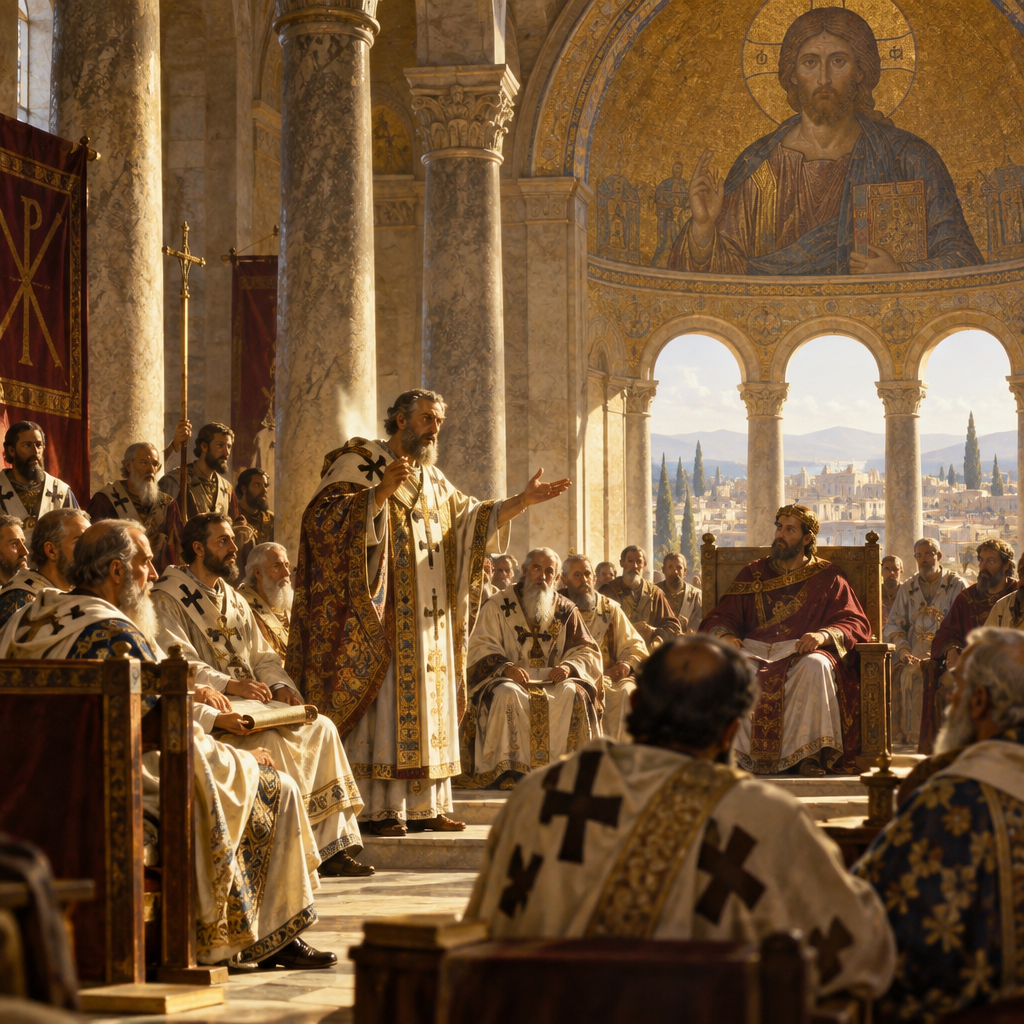
In 325, bishops gathered at Nicaea, a city in what is now Türkiye, to address a dispute that threatened the Church’s unity. Their answer helped give lasting expression to the Christian confession of Jesus as truly divine.
Why the bishops gathered
The controversy centred on Arius, a priest from Alexandria. He taught that the Son did not exist eternally in the same way as the Father. Although Arius gave the Son an exalted place above all other creatures, his teaching meant that the Son was not fully God as the Father is God.
His opponents recognised what was at stake. Christians worshipped Jesus, baptised in the name of the Father, Son and Holy Spirit, and trusted Christ to bring them into communion with God. If the Son were a creature, how could that worship and hope be understood?
Emperor Constantine summoned the council, hoping to restore religious unity within his empire. More than 250 bishops attended, predominantly from the eastern parts of the Christian world; the traditional number is 318.
Constantine’s political interests mattered, but the theological question belonged to the Church. The bishops had to judge how faithfully different claims about Jesus expressed the faith they had received.
“Begotten, not made”
Nicaea rejected the claim that the Son had been created or had begun to exist. Its creed confessed him as “begotten, not made” and of the same substance as the Father.
The key Greek word was homoousios. In the English translation used at Catholic Mass, this is expressed as “consubstantial”. The word can sound forbidding, but its purpose is wonderfully direct: the Son is not a lesser god or an exceptionally holy creature. He truly shares the one divine nature with the Father.
“Begotten” here does not describe a birth within time or a physical process. It points to the Son’s eternal relationship with the Father. There was never a time when the Father existed without the Son.
The council was not inventing Christ’s divinity. It was defending and clarifying a faith already expressed in Christian worship and Scripture, including the opening of John’s Gospel (John 1:1–18).
Is this the Creed we say at Mass?
Yes—with an important historical distinction.
The creed produced at Nicaea in 325 is not word for word the longer Creed commonly recited at Mass today. The familiar text is associated with the First Council of Constantinople in 381 and is often called the Nicene-Constantinopolitan Creed, or simply the Nicene Creed.
It retains Nicaea’s central confession of the Son’s full divinity while giving a fuller profession of faith in the Holy Spirit, the Church, baptism, the resurrection and everlasting life.
The wording also has a later history. In Western Christianity, the phrase “and the Son” was added to the statement about the Holy Spirit’s procession. That addition became a significant point of disagreement between Eastern and Western Christians.
So the Creed’s history did not end in 325. Yet Nicaea remains its decisive foundation.
What Nicaea did not do
Nicaea did not choose which books belong in the Bible, despite a persistent modern myth. Nor did a single meeting end the controversy over Christ’s divinity.
Decades of theological argument, imperial pressure and exile followed. St Athanasius, who attended Nicaea as a deacon accompanying his bishop, later became one of its most steadfast defenders.
The council also addressed practical questions of Church discipline and the common celebration of Easter. But its enduring legacy is its confession of who Jesus Christ is.
More than words to recite
The Creed is not a substitute for a living relationship with God. It helps guard the truth of the One whom we love and worship.
When we profess it, we join generations of Christians who have entrusted their lives to Christ—not merely a teacher pointing towards God, but the eternal Son who became truly human for our salvation.
The next time those familiar words pass our lips, we might pause inwardly at their extraordinary promise: in Jesus, God himself has drawn near.