St Peter’s Basilica: A Church Built Around a Fisherman’s Faith
Discover how a fisherman’s burial place became St Peter’s Basilica—and why this magnificent church still points beyond itself.
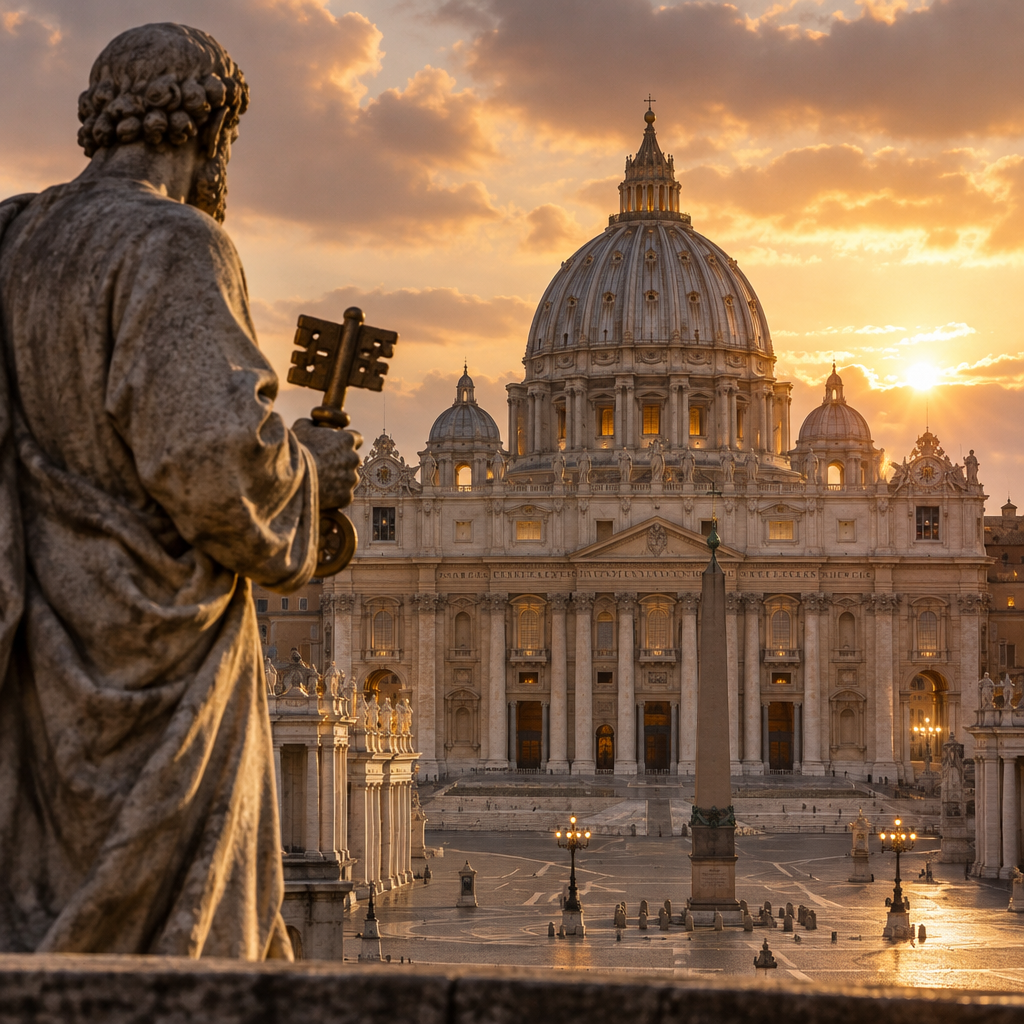
A fisherman from Galilee might seem an unlikely person to have one of the world’s most magnificent churches built over his burial place. Yet that contrast lies at the heart of St Peter’s Basilica: immense beauty surrounding the memory of a man whose strength came through grace, not perfection.
As the basilica approaches the 400th anniversary of its dedication on 18 November 2026, its history offers more than a story of architecture. It opens a window onto Christian memory, human failure and the patient work of faith.
Before the dome, there was a grave
Catholic tradition holds that St Peter was martyred in Rome during the persecution under Emperor Nero, in the first century. Tradition also holds that he was crucified upside down, considering himself unworthy to die in the same manner as Jesus. That detail comes from later Christian testimony, rather than the New Testament.
The Vatican area lay outside the ancient city’s main centre and included a burial ground. Early Christians venerated a site there as Peter’s tomb.
Excavations beneath the present basilica in the twentieth century uncovered an ancient necropolis and evidence of a memorial associated with Peter. These discoveries illuminate the very early devotion attached to this place, although identifying particular human remains with complete historical certainty is more difficult.
The essential point is that the church did not create the memory of Peter here. It was built around an existing place of Christian remembrance.
Constantine’s great church
In the fourth century, after Christianity gained legal toleration in the Roman Empire, Emperor Constantine sponsored a large basilica over the site venerated as Peter’s burial place.
Building there was no simple choice. The sloping ground required substantial engineering, and the project affected an existing cemetery. The location mattered enough to justify the difficulty.
For more than a thousand years, this first St Peter’s welcomed worshippers and pilgrims. It also witnessed major events in European history: Charlemagne was crowned emperor there by Pope Leo III on Christmas Day in the year 800.
But the building aged. By the Renaissance, concerns about its condition, together with ambitious plans for renewal, led towards a new basilica.
A building shaped by many hands
Pope Julius II laid the foundation stone of the present church on 18 April 1506. What followed was not one architect’s uninterrupted vision, but a long process involving changing designs, successive popes and generations of skilled workers.
Donato Bramante produced an influential early plan. Michelangelo later reshaped the project and designed the great dome, though he died before its completion. Carlo Maderno extended the nave and created the façade.
Pope Urban VIII dedicated the new basilica on 18 November 1626. Further artistic work continued afterwards, including Gian Lorenzo Bernini’s great colonnades surrounding the square.
Their embracing shape offers a fitting image of welcome. Yet the grandeur also invites a searching question: does beauty help us turn towards God and towards our neighbour?
Beauty, money and a painful chapter
An honest history must acknowledge that the rebuilding of St Peter’s was connected with one of Christianity’s deepest divisions.
A campaign involving indulgences helped raise money for the project. Abuses in their preaching and administration became a major focus of Martin Luther’s protest in 1517 and part of the wider upheaval of the Reformation.
Catholic teaching does not hold that forgiveness or salvation can be bought. Nevertheless, practices surrounding indulgences could obscure that truth, and the Church subsequently took measures against abuses.
St Peter’s therefore carries a history of extraordinary devotion alongside a reminder that religious institutions always need repentance and reform.
Not Rome’s cathedral—and not the final destination
Despite its prominence, St Peter’s is not the cathedral of Rome. That distinction belongs to the Archbasilica of St John Lateran, which houses the bishop of Rome’s cathedral chair.
St Peter’s has another particular role: it gathers pilgrims around the memory of the apostle whom Catholics recognise as the first pope.
Peter himself directs our attention beyond stone and splendour. The Gospels show him denying Jesus, then receiving mercy and a renewed call to care for Christ’s flock (Luke 22:54–62; John 21:15–19).
Beneath the magnificent dome is a deeply human story: failure need not have the last word. Christ can still call a wounded disciple to love, serve and begin again.