St Peter’s Basilica: A Church Built Around an Apostle’s Memory
From an ancient burial ground to Michelangelo’s dome, discover the history and enduring Christian hope of St Peter’s Basilica.
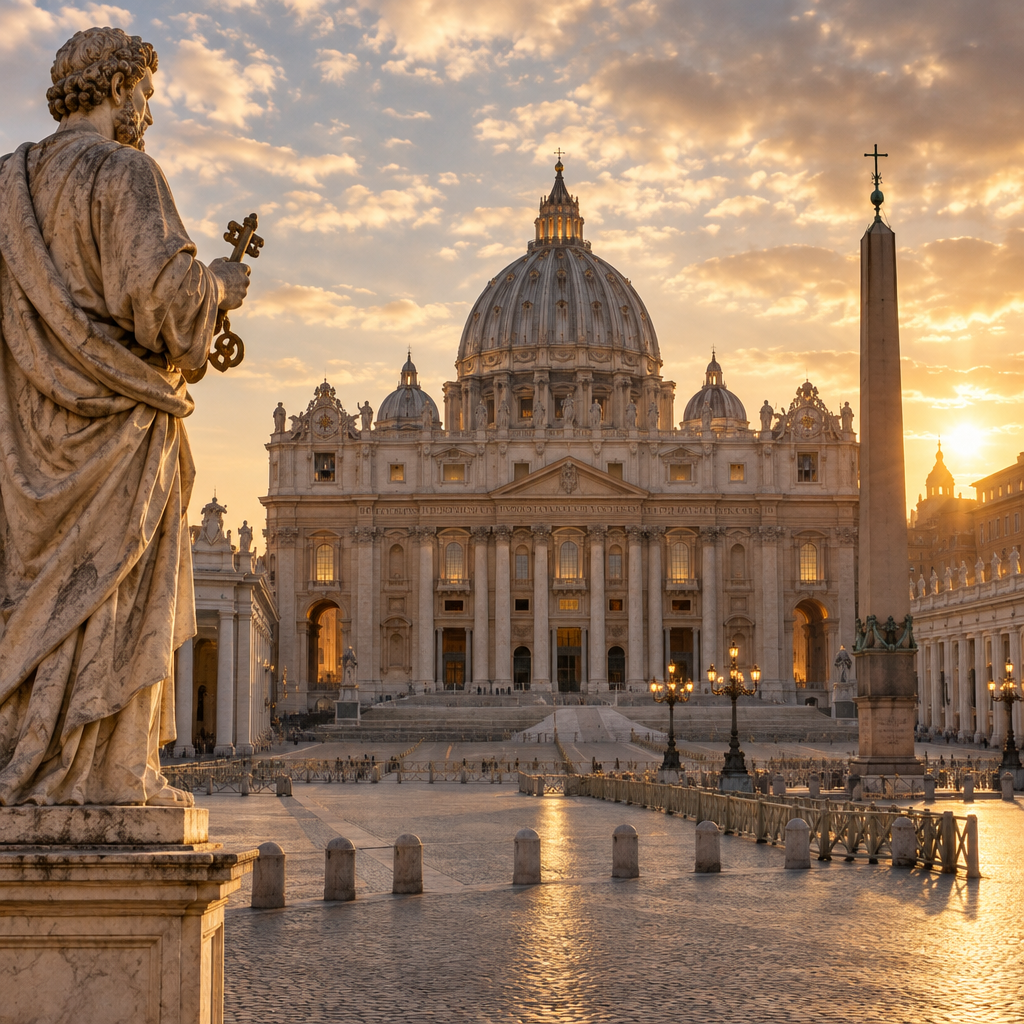
Before its vast dome rose above Rome, before its marble floors and sweeping colonnades, the site of St Peter’s Basilica was a burial ground beside an ancient place of public spectacle. Its story begins not with architectural ambition, but with the Christian memory of an apostle who died for his faith.
For nearly seventeen centuries, churches on this spot have welcomed pilgrims seeking to draw closer to Christ through the witness of St Peter.
Why this place mattered
Catholic tradition holds that Peter was martyred in Rome during the persecution under Emperor Nero, commonly dated to the AD 60s. Tradition also holds that he was crucified upside down. The precise circumstances cannot all be independently verified, but Peter’s association with Rome and his martyrdom have deep roots in early Christian testimony.
Christians came to venerate a burial place on the Vatican Hill as his tomb. Around AD 200, a Roman Christian writer named Gaius referred to a memorial associated with Peter at the Vatican.
Twentieth-century excavations beneath the basilica uncovered an ancient cemetery and a small second-century monument in the area long honoured as Peter’s burial place. These discoveries illuminate the antiquity of the site’s veneration, though identifying particular human remains is a more complex question.
Constantine’s first basilica
In the fourth century, Emperor Constantine sponsored a great basilica over the revered site. Construction began in the 320s, requiring substantial work to create a level platform on the sloping hillside.
The building was arranged around the memorial of Peter. This mattered: the church’s location was determined by devotion to the apostle, despite the difficulties of the terrain.
Old St Peter’s, as it is now called, had a long central nave, side aisles and a spacious courtyard. Over the centuries, it became a major destination for pilgrimage and a setting for momentous events. On Christmas Day in the year 800, Pope Leo III crowned Charlemagne emperor there.
Yet even a beloved church cannot escape the effects of time. After more than a thousand years, the ancient basilica needed extensive repair. Proposals for renewal eventually became something far more ambitious: a new St Peter’s.
A rebuilding that took generations
Pope Julius II laid the foundation stone of the present basilica in 1506. Donato Bramante’s initial design imagined a monumental church centred beneath a great dome.
The project passed through many hands, and its plans changed repeatedly. Raphael, Antonio da Sangallo the Younger and other architects contributed before Michelangelo took charge in 1546. Already in his seventies, Michelangelo simplified the design and gave the building much of its powerful architectural unity.
He did not live to see the dome completed. Giacomo della Porta, working with Domenico Fontana, brought it to completion in 1590, drawing on Michelangelo’s design while modifying its profile.
In the early seventeenth century, Carlo Maderno extended the nave and created the façade. Pope Urban VIII consecrated the new basilica in 1626: 120 years after its foundation stone was laid.
Beauty, controversy and reform
The rebuilding also belongs to a painful chapter of Church history. Fundraising connected with the project included indulgence preaching whose abuses helped provoke Martin Luther’s protest in 1517.
Catholic teaching does not understand an indulgence as buying forgiveness. Nevertheless, the ways indulgences were sometimes promoted caused grave scandal. The Council of Trent later called for abuses to be corrected and condemned financial gain connected with them.
Remembering this honestly need not diminish the basilica’s beauty. It reminds us that the Church’s history includes both extraordinary devotion and a continuing need for repentance and reform.
Bernini’s welcoming arms
Gian Lorenzo Bernini helped shape the basilica and its surroundings as pilgrims know them today. His monumental bronze baldachin marks the papal altar above the area traditionally identified with Peter’s tomb.
Outside, his seventeenth-century colonnades embrace St Peter’s Square. Bernini understood their sweeping form as an image of the Church’s maternal welcome.
Despite its prominence, St Peter’s is not Rome’s cathedral. That distinction belongs to the Archbasilica of St John Lateran, the cathedral of the Bishop of Rome, the Pope.
More than a monument
St Peter’s is a masterpiece, but its deepest meaning is not found in its scale. Beneath the grandeur lies the memory of a fisherman called by Jesus: a disciple who failed, received mercy and was entrusted with caring for Christ’s flock (John 21:15–19).
Its long history invites us to look beyond the stone towards the Lord whom Peter followed. Even amid human weakness, Christ continues to call his people to faithfulness, repentance and hope.