St Peter’s Basilica: Four Centuries of a Church Built on Memory
As St Peter’s Basilica approaches 400 years since its dedication, discover the older Christian story beneath its magnificent dome.
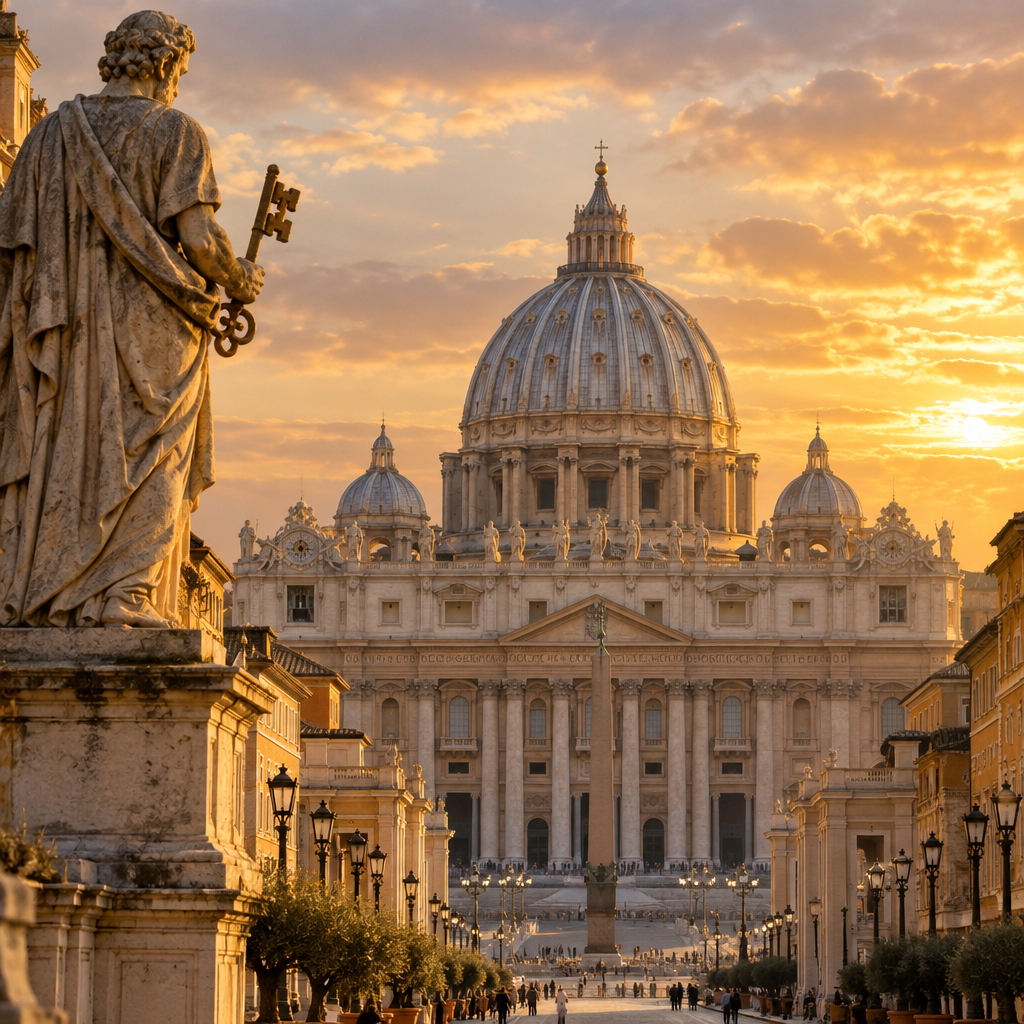
A church can be so famous that we stop asking why it stands where it does. St Peter’s Basilica is one of those places: its dome rises above Rome, its vast interior fills our screens at papal liturgies, and its square welcomes pilgrims from across the world.
On Tuesday, 3 November 2026, we are just over a fortnight away from a remarkable anniversary. The present basilica was dedicated on 18 November 1626. Four hundred years later, its deepest meaning still lies beneath its splendour: the memory of a fisherman who followed Jesus.
Why build here?
Catholic tradition holds that the Apostle Peter suffered martyrdom in Rome under the emperor Nero and was buried on the Vatican Hill. Early Christian testimony connects this area with the memorial of Peter’s burial.
In the fourth century, the emperor Constantine sponsored a great basilica over the site Christians venerated as Peter’s tomb. Building there was not the easiest option. The hillside and existing burial ground required substantial work. The location mattered more than convenience.
Excavations beneath the present basilica in the twentieth century revealed an ancient necropolis and evidence of early veneration at the site associated with Peter. Archaeology does not settle every question about the remains found there, but it helps us understand how deeply the church is rooted in this place.
The basilica before the basilica
Constantine’s church stood for more than a thousand years. Pilgrims prayed there, popes celebrated worship there, and generations brought their hopes and sorrows to the apostle’s shrine.
It also witnessed events that shaped Europe. On Christmas Day in the year 800, Pope Leo III crowned Charlemagne emperor in the old St Peter’s.
By the Renaissance, however, the ancient building had serious structural problems. Proposals to repair or replace it developed over decades. In 1506, Pope Julius II laid the foundation stone for a new basilica.
The decision was momentous. Rebuilding meant dismantling a church cherished by centuries of Christians. The familiar monument we admire today emerged through difficult choices, changing plans and work that continued long beyond any one lifetime.
A building no single person could finish
Donato Bramante produced the first major design for the new church. Other architects followed, each inheriting both a vision and a challenge.
Michelangelo took charge in 1546. His work gave the building much of its monumental unity, especially through his design for the dome. Yet he died before that dome was completed. Giacomo della Porta, working with Domenico Fontana, brought its construction to completion in 1590.
Carlo Maderno later extended the nave and designed the façade. Pope Urban VIII dedicated the basilica on 18 November 1626, although decoration and work around it continued afterwards.
Bernini’s great colonnades would later give the square its embracing shape. What appears to visitors as one harmonious whole is, in fact, the fruit of many hands and generations.
Is St Peter’s the Pope’s cathedral?
Surprisingly, no. The cathedral of the Bishop of Rome is the Archbasilica of St John Lateran.
A cathedral is defined by the bishop’s chair, or cathedra, not by its size or fame. St Peter’s has a unique importance because of its connection with the apostle and its role in the life of the papacy, but it is not Rome’s cathedral.
That distinction reminds us that the Church’s history is richer than its most recognisable image.
What the stones point towards
Catholics do not honour Peter because he was flawless. The Gospels show his courage, confusion and denial. They also show Christ restoring him and entrusting him with the care of his flock (John 21:15–19).
That is a hopeful foundation for a church: not human perfection, but the mercy and faithfulness of Jesus.
As the basilica approaches its four-hundredth anniversary, its story invites us to look beyond marble and magnificence. Buildings preserve memory, but living faith must be received and practised anew.
We may never stand beneath that great dome. Yet wherever we are, Christ still calls imperfect disciples to love him and care for others.