Saint of the Day: St John Paul II (22 October)
Discover St John Paul II’s journey from wartime Poland to the papacy, and his enduring invitation to open our hearts to Christ.
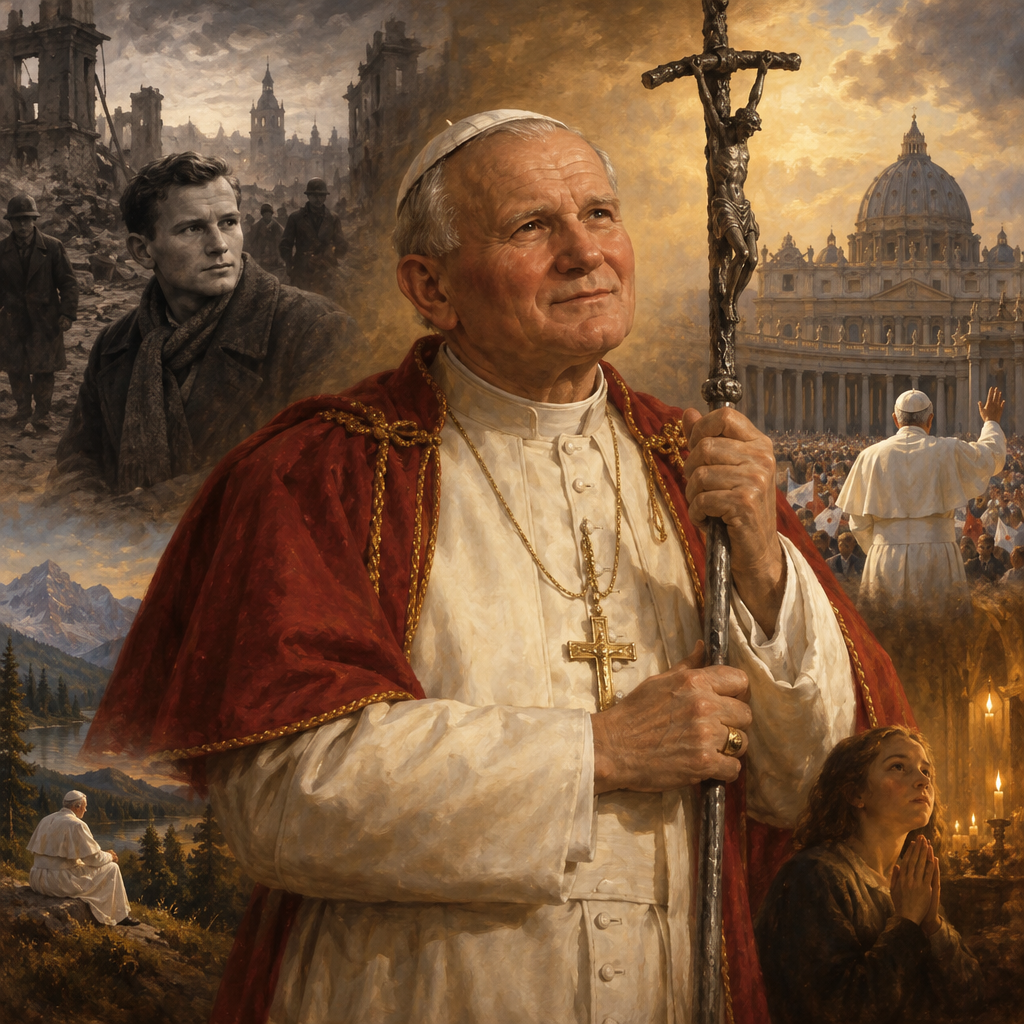
“Do not be afraid. Open wide the doors for Christ!”
St John Paul II spoke these words at the inauguration of his pontificate on 22 October 1978. They were not the easy optimism of someone untouched by suffering. They came from a man who had known bereavement, war and oppression—and had discovered that Christ’s love could sustain him through them.
On Thursday, 22 October 2026, we honour this pope and saint, whose annual celebration recalls the beginning of his ministry as shepherd of the universal Church.
A vocation formed through loss
Karol Józef Wojtyła was born in Wadowice, Poland, on 18 May 1920. His mother died when he was eight; his older brother Edmund, a doctor, died in 1932. His father died in 1941. Before he turned twenty-one, Karol had lost his immediate family.
He loved literature, theatre and the possibilities of language. Yet the Nazi occupation of Poland brought his university studies to a halt. He worked in a quarry and a chemical factory, encountering the exhaustion and vulnerability of working life.
In 1942, he began studying for the priesthood in a clandestine seminary in Kraków. Ordained in 1946, he later served as a parish priest, university teacher and bishop. His pastoral work brought him close to young people and families, whose questions and struggles remained central to his ministry.
A pope who crossed boundaries
Elected pope on 16 October 1978, John Paul II became the first non-Italian pope in more than four centuries.
Throughout his long pontificate, he travelled widely, preaching Christ and defending the dignity of every human person. His experience of Nazi occupation and communist rule gave particular urgency to his defence of religious freedom and his opposition to systems that treated people as expendable.
He helped establish World Youth Day, inviting young people to discover that holiness was not a remote ideal but a calling for their own lives. His teaching on marriage, the human body and love emphasised that people are never objects to be used, but persons called to give and receive love.
He also fostered dialogue with other Christians and with people of other religions, including a historic visit to Rome’s synagogue in 1986.
Forgiveness made visible
On 13 May 1981, John Paul II was shot in St Peter’s Square. He survived and publicly forgave his attacker, Mehmet Ali Ağca. In 1983, he visited him in prison.
That encounter gave visible expression to a demanding Christian truth: mercy does not deny wrongdoing, but refuses to let hatred have the final word.
In his later years, Parkinson’s disease increasingly limited his movement and speech. His frailty reminded the world that human dignity does not depend on strength, productivity or independence. He died on 2 April 2005 and was canonised in 2014.
Why he matters today
John Paul II’s invitation remains searching: where are we afraid to let Christ enter?
We may not be called to address crowds or travel the world. We can welcome Christ into an anxious decision, protect someone’s dignity, seek reconciliation or remain patiently beside a person who is suffering. Courage often begins with one small act of trust.
A prayer for his intercession
St John Paul II, pray for us that we may open our hearts to Jesus Christ. Ask the Lord to strengthen our faith, deepen our mercy and teach us to honour every human life. Accompany young people, families and all who carry illness or grief. May we follow Christ with courage and hope. Amen.
Do not be afraid to take the next small step towards Christ.