Saint of the Day: St Frumentius (27 October)
Taken captive as a young man, St Frumentius became a bishop who helped Christianity take root in Ethiopia. Discover his story and pray.
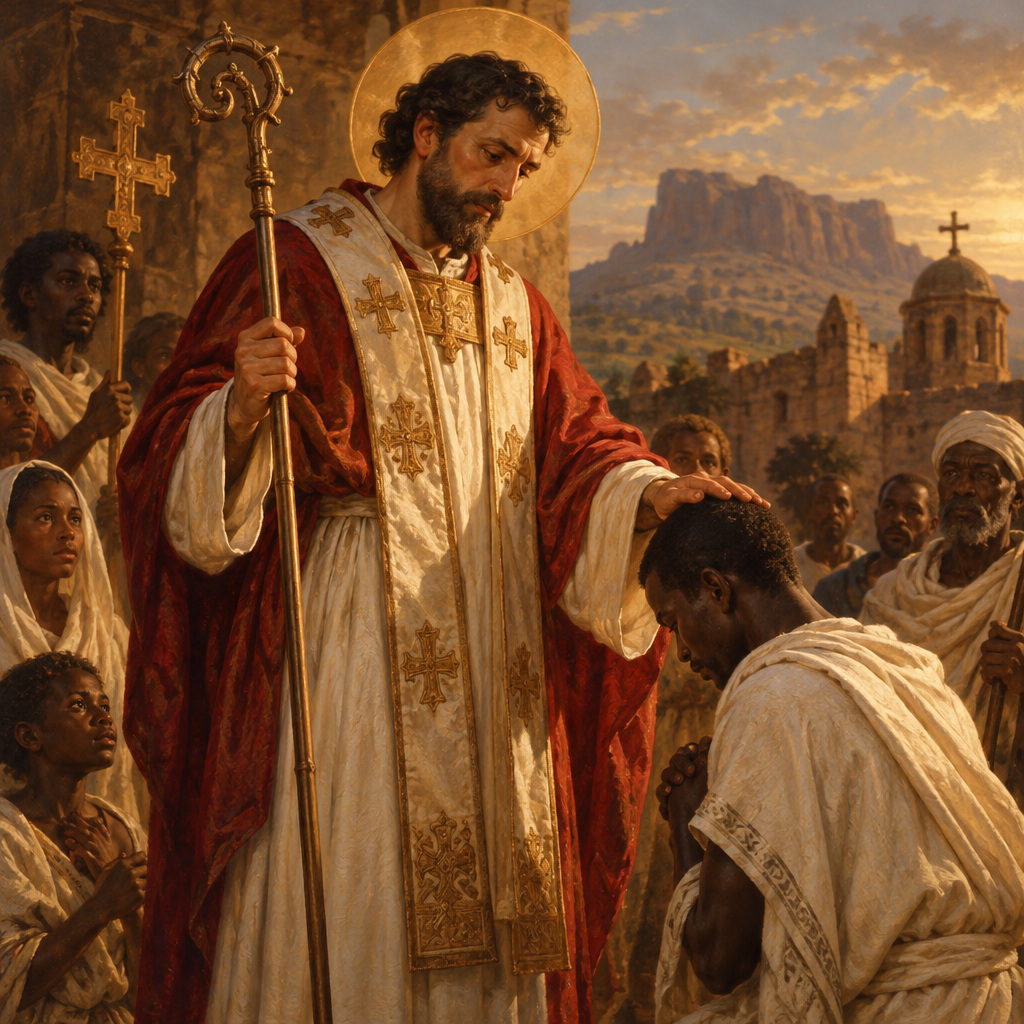
He arrived in a foreign kingdom as a captive; he became a bishop who helped a nation encounter Christ. St Frumentius, traditionally remembered on 27 October, shows how a life disrupted by suffering can still become a life of extraordinary service.
His story belongs to the fourth century, yet its questions feel close to home: what can we do when our plans collapse? Can faith bear fruit somewhere we never intended to be?
From captivity to responsibility
Frumentius came from the eastern Mediterranean world. According to the early Christian account preserved by the historian Rufinus, he and his companion Aedesius were travelling with a scholar named Meropius when their ship stopped at a port on the Red Sea.
An attack killed their travelling companions. The two young men survived but were taken captive and brought into the service of the king of Aksum, a powerful kingdom centred in what is now northern Ethiopia and Eritrea.
Frumentius gained the king’s confidence and was entrusted with considerable responsibility. After the king’s death, the queen asked the two men to remain and help during her son’s minority, although they had been granted their freedom.
They stayed. What began as forced displacement became an opportunity for patient, generous service.
Making room for the Gospel
While serving at court, Frumentius encouraged Christian merchants living in the kingdom to gather for worship. He helped create space for the faith to be practised and, gradually, to become more widely known.
This was not yet the work of a bishop. It was the work of a Christian using the responsibilities already before him.
Eventually, Frumentius travelled to Alexandria and spoke to St Athanasius about the Christian community growing in Aksum. He asked that a bishop be sent to care for it.
Athanasius recognised that Frumentius himself was suited to the task. He consecrated him bishop and sent him back.
The man who had once reached Aksum without freedom returned with a mission: to shepherd its Christians and proclaim the Gospel.
A lasting Christian inheritance
Frumentius is honoured as the first bishop of Aksum and as the Apostle of Ethiopia. His ministry helped establish Christianity there during the reign of King Ezana, whose conversion marked a decisive moment in the kingdom’s history.
Ethiopian Christians remember Frumentius with deep affection as Abba Salama, commonly understood as “Father of Peace”. His legacy belongs to one of the world’s oldest living Christian traditions.
We should not imagine that one man accomplished everything alone. Yet his life reminds us how profoundly one faithful person can contribute to a community’s future.
Why he matters today
Frumentius does not teach us to call suffering good. Captivity and violence remain grave evils. Rather, his witness encourages us to trust that evil need not have the final word.
We may never lead a mission or shape a nation. We can still make room for prayer, support a lonely neighbour, welcome someone far from home, or serve faithfully in an unexpected responsibility.
Holiness often begins there: not in the life we imagined, but in the next loving response we can make.
A prayer for his intercession
St Frumentius, faithful shepherd and father of peace, pray for us. Ask the Lord to strengthen those uprooted from their homes, sustain the Christians of Ethiopia and Eritrea, and teach us to serve with courage and gentleness. May we recognise opportunities to love, even when our plans have changed. Through Christ our Lord. Amen.