A Pilgrimage to Montserrat: Prayer Before La Moreneta
Discover Montserrat Abbey and La Moreneta, with history, sacred sights and practical advice for a prayerful pilgrimage from Barcelona.
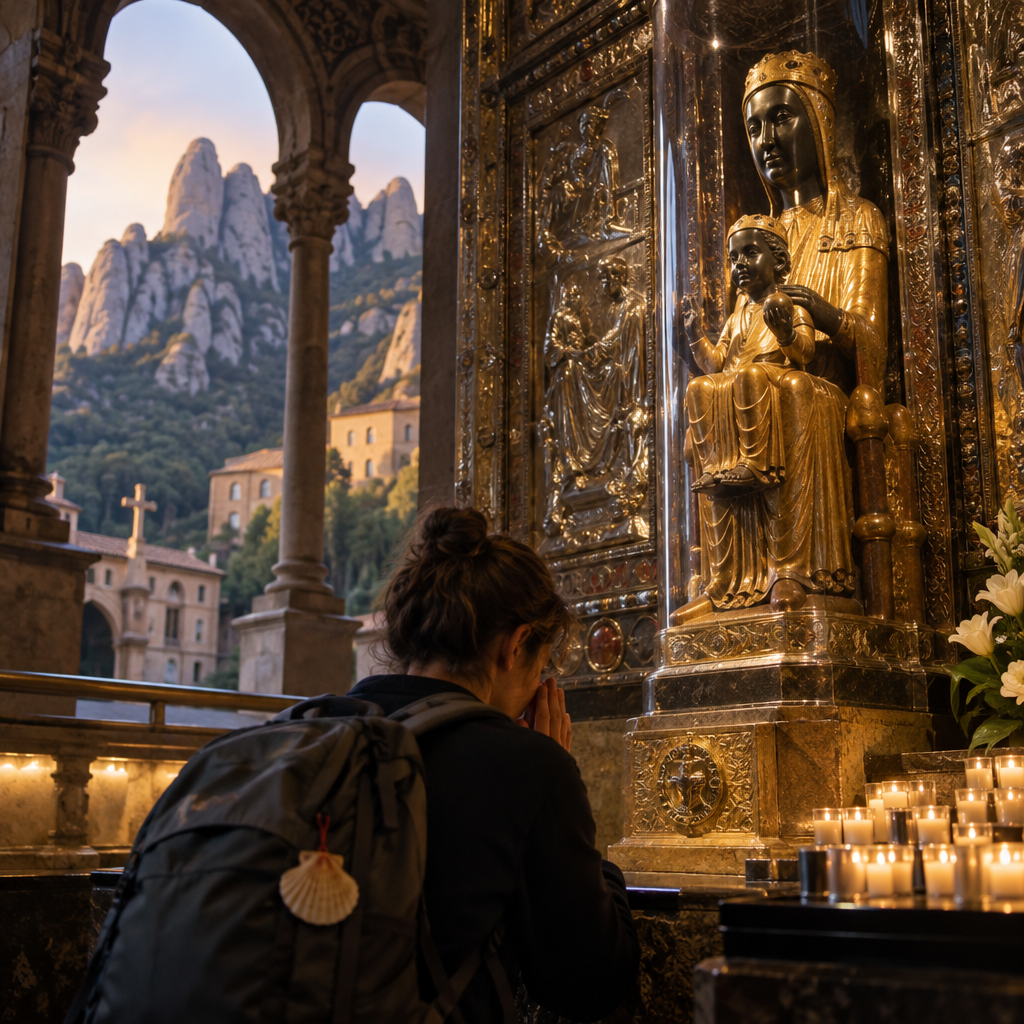
A mountain that invites us to pause
Above the countryside of Catalonia, the jagged peaks of Montserrat rise like a great stone sanctuary. About 50 kilometres north-west of Barcelona, this mountain has drawn pilgrims for centuries to the Benedictine Abbey of Santa Maria de Montserrat and its beloved image of Our Lady, known as La Moreneta.
You need not arrive with perfect faith or carefully prepared prayers. Bring your gratitude, your questions, or simply your weariness. A pilgrimage here can begin with the quiet desire to make room for God.
The story of La Moreneta
Tradition holds that shepherd children discovered an image of the Virgin Mary in a mountain cave in 880, after seeing a mysterious light. Tradition also holds that attempts to carry the image away failed when it became extraordinarily heavy, understood as a sign that it should remain on Montserrat.
The statue venerated today is a Romanesque wooden carving generally dated to the late twelfth century. Its documented artistic history should therefore be distinguished from the much earlier discovery story.
Mary sits enthroned with the Christ Child on her lap. Her dark face and hands have given rise to the affectionate Catalan name La Moreneta, often translated as “the little dark one”. She holds an orb, while the Child raises a hand in blessing.
For Catholics, devotion to this image is not worship of a statue. It is an expression of love for Mary, the Mother of Jesus, whose vocation always points towards her Son. Before La Moreneta, a simple prayer is enough: Mary, help me to listen to Jesus and follow Him.
A thousand years of Benedictine prayer
Abbot Oliba founded the monastery in 1025, establishing a Benedictine community beside an existing Marian sanctuary. Across the centuries, Montserrat became a major centre of pilgrimage and a cherished place in Catalan religious and cultural life.
Its history includes suffering as well as renewal. Napoleon’s troops devastated the monastery in the early nineteenth century, and later upheavals brought further losses. The community rebuilt, preserving its vocation of prayer and hospitality.
In 1881, Pope Leo XIII proclaimed Our Lady of Montserrat patroness of Catalonia. Today, Benedictine monks continue their life of communal prayer, work and welcome. Visitors enter not merely a historic monument, but a living monastery.
What to see and where to pray
Begin in the basilica. Although its fabric has been restored and altered over time, it remains the spiritual heart of a visit. Pause before taking photographs: a few minutes of silence can change the character of the whole day.
La Moreneta is housed above the high altar and approached through a dedicated access route. Arrangements for visiting the image can differ from those for entering the basilica, so check the official Montserrat website and reserve the appropriate access in advance when required.
If the timetable allows, attend Mass or listen to the Escolania, Montserrat’s renowned boys’ choir. Its roots reach back to the Middle Ages. Singing schedules vary with the school year, holidays and worship commitments; do not assume a performance will take place every day.
The Santa Cova, or Holy Cave, marks the place associated with the discovery tradition. Its chapel is reached by a mountain path, with a funicular sometimes reducing part of the journey. Check operating conditions and allow for gradients and the return walk.
The Museum of Montserrat offers another rewarding stop, with archaeology and works by major artists. For wider mountain views, consider the Sant Joan funicular and a suitable walking route, keeping your abilities and the weather in mind.
Getting there and choosing your time
From Barcelona, take an FGC train on line R5 from Plaça Espanya towards Manresa. For the cable car, leave at Aeri de Montserrat. For the rack railway, continue to Monistrol de Montserrat. These are different stations: choose your mountain ascent before buying a combined ticket.
Driving is also possible, but mountain roads and limited parking make public transport an attractive option. Check current timetables, maintenance closures and the last return connections before setting out.
Spring and autumn often offer comfortable walking weather, although conditions can change quickly. Summer can be hot and crowded; winter may bring cold, wind or icy paths. An early weekday arrival generally gives more space for quiet prayer. Sundays and major religious celebrations can be especially busy.
What to bring—and what to leave room for
Wear supportive shoes and bring water, a sunhat, sunscreen and a light waterproof or warm layer. Mountain temperatures can differ noticeably from Barcelona’s. Dress respectfully for the basilica, with shoulders and knees covered.
Carry any booking confirmations and leave generous time between transport, worship and walking. If you have limited mobility, consult the abbey’s accessibility information: not every mountain path or approach is step-free.
Above all, resist the pressure to see everything. One unhurried prayer may matter more than another viewpoint. Let Montserrat be a place where you receive, rather than achieve—and allow Mary’s quiet witness to turn your heart towards Christ.