Prayer at the Edge of the World: Ireland’s Early Monasteries
Explore Glendalough, Clonmacnoise and Skellig Michael: three Irish monastic sites where prayer, learning and daily work shaped Christian life.
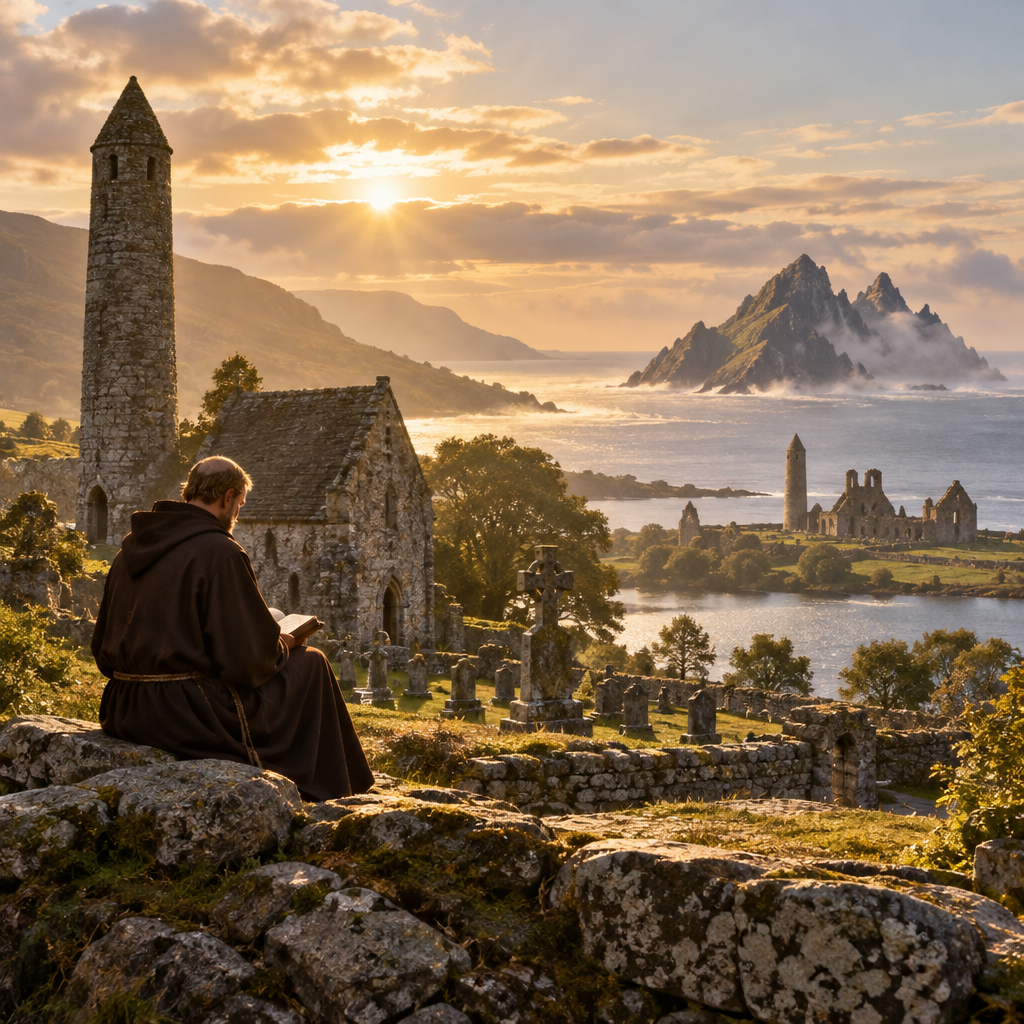
A landscape shaped by prayer
A valley sheltered by mountains. A settlement beside the River Shannon. A rocky island rising from the Atlantic. Glendalough, Clonmacnoise and Skellig Michael reveal three strikingly different settings for early Irish monastic life.
Yet each grew from the same Christian desire: to seek God through prayer, community and a disciplined life. Their surviving ruins invite us to imagine not only extraordinary saints, but ordinary days of worship, work, study and hospitality.
How monastic life took root
Christianity was present in Ireland before Saint Patrick’s mission in the fifth century. During the sixth century, monasteries became increasingly important centres of religious life, drawing on the wider Christian tradition of men and women dedicating themselves to God.
There was no single pattern followed everywhere. Some communities sought solitude in remote places; others developed into substantial settlements connected with powerful families, trade routes and local society. Bishops remained important, while abbots and abbesses could exercise considerable influence.
Prayer shaped the day, but monasteries also needed food, shelter and skilled labour. Some became centres of scholarship and manuscript production. Irish monks later travelled abroad, helping establish communities and sustain Christian learning across parts of Britain and continental Europe.
Glendalough: solitude that gathered a community
In County Wicklow, Glendalough is closely associated with Saint Kevin, who lived in the sixth and early seventh centuries. Tradition holds that he sought a life of prayer and solitude in the valley, and that a community gathered around him.
Stories about Kevin’s closeness to animals belong to the devotional traditions surrounding his life. They express an ideal of holiness at peace with creation, but should not all be read as documented biography.
What is certain is that Glendalough became an important monastic and pilgrimage centre. Its surviving buildings developed over several centuries: the round tower and stone churches we see today were not all standing in Kevin’s lifetime.
The round tower served as a bell tower and could also provide storage and refuge. It was part of a living religious settlement, not simply a mysterious monument. Glendalough reminds us that a search for silence can bear fruit in community.
Clonmacnoise: prayer at a crossroads
Saint Ciarán founded Clonmacnoise beside the Shannon in the mid-sixth century, traditionally dated to 544 or 545. Its position near important river and overland routes helped it become a major centre of worship, learning and patronage.
This was not a monastery cut off from the world. Rulers supported it, craftspeople worked there, and its churches and burial places drew people from far beyond the immediate area.
Its surviving high crosses reveal how faith could be expressed through carved stone. Biblical scenes and Christian symbols made the landscape itself a setting for remembrance and devotion.
Clonmacnoise also complicates the romantic picture of peaceful monasteries untouched by history. It suffered raids and violence, including attacks by both Viking and Irish forces. Its story includes learning and holiness, but also vulnerability within a troubled political world.
Skellig Michael: a demanding place to seek God
Off the coast of County Kerry, Skellig Michael offers perhaps the most dramatic image of Irish monasticism. Stone steps climb towards a small monastic settlement, where dry-stone cells and places of worship cling to the steep island.
The monastery’s exact foundation date is uncertain. Its early history is less securely documented than popular retellings sometimes suggest.
Life here required practical ingenuity as well as spiritual resolve. Collecting rainwater, obtaining food and maintaining buildings were essential to survival. The island’s isolation offered a demanding setting for prayer, though the community was not wholly disconnected from the mainland.
Its remoteness recalls the Christian tradition of seeking a “desert”: a place where distractions are stripped away and dependence on God becomes more tangible.
More than beautiful ruins
These three sites show that early Irish monasticism was neither uniform nor merely romantic. It could flourish beside busy routes, within a mountain valley or on an Atlantic rock.
For Catholics, their deepest legacy is not architectural. It is the conviction that prayer belongs at the heart of life—and that learning, labour and hospitality can become offerings to God.
We need not cross an ocean to begin. A little faithful silence, a task done lovingly and a welcome offered generously can make room for God wherever we live.