A Pilgrim’s Guide to Loreto and the Holy House
Discover Loreto’s Holy House: its story, sacred art and practical advice for a prayerful pilgrimage to this Marian shrine in Italy.
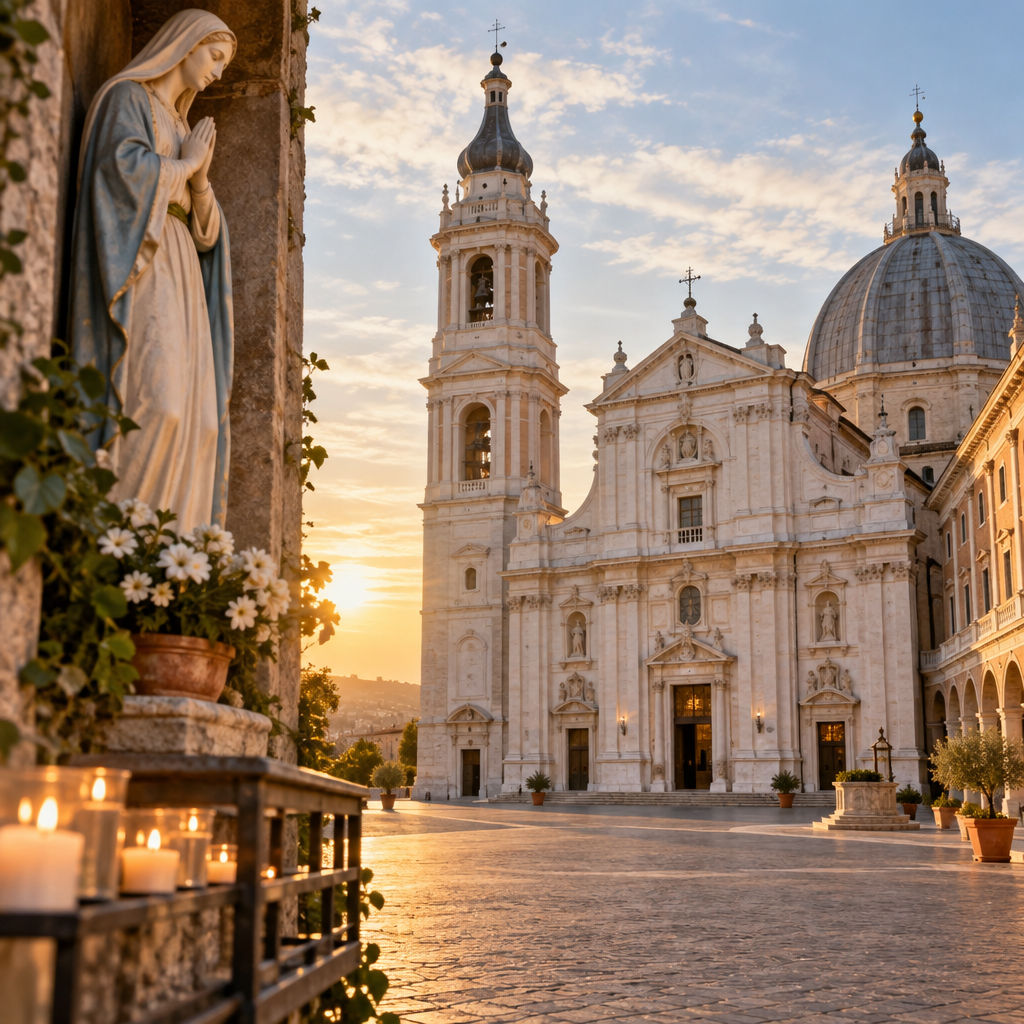
Some holy places draw us towards the extraordinary. Loreto also draws us towards the ordinary: a home, a family, a life of work and prayer. In the hills of Italy’s Marche region, overlooking the countryside towards the Adriatic, its great basilica shelters a small stone house associated with the Virgin Mary’s home in Nazareth.
For pilgrims, the heart of a visit is not simply an ancient building. It is the mystery of the Incarnation: God entering human life, and Mary freely welcoming his call.
The story of the Holy House
Tradition holds that the Holy House was the home in Nazareth where Mary received the angel Gabriel’s announcement and consented to become the mother of Jesus. The Gospel recounts the Annunciation in Luke 1:26–38, though it does not describe the house preserved at Loreto.
Tradition holds that angels carried the house from the Holy Land to the Adriatic region in 1291, and that it reached the Loreto area in 1294. This beloved account has shaped centuries of Marian devotion and the shrine’s particular association with air travel.
Historical discussion is more complex. Researchers have examined the masonry and evidence suggesting that stones from a dwelling in Nazareth may have been transported by people during the upheavals surrounding the end of the Crusader presence in the Holy Land. A proposed connection with a family named Angeli is often mentioned, but the precise circumstances of the transfer remain debated.
It is worth keeping those distinctions clear: the miraculous journey belongs to the shrine’s tradition; the historical questions should not be presented as conclusively settled. Neither uncertainty nor curiosity need prevent a sincere visit centred on Christ.
A shrine shaped by centuries
Loreto became one of Europe’s great Marian pilgrimage destinations. Construction of the present basilica began in 1469, and successive generations of patrons and artists enriched the sanctuary around the modest structure at its centre.
Its architecture has a striking, almost fortified character, reflecting an age when coastal communities faced threats from the sea. Inside, the scale and splendour of the church contrast with the rough simplicity of the Holy House.
In 1920, Pope Benedict XV proclaimed Our Lady of Loreto patroness of aviators. The devotion also reaches far beyond Italy through the Litany of Loreto, whose invocations honour Mary and ask for her prayers.
What to see and how to pray
Begin with the Holy House itself. Its three stone walls are enclosed within an elaborate marble casing; the traditional explanation is that the original dwelling stood against a grotto in Nazareth, which formed its remaining side.
Inside, allow time for silence before the image of Our Lady of Loreto. The present dark-coloured statue of Mary and the Christ Child replaced an earlier image destroyed by fire in 1921. Resist the pressure to see everything immediately. A few unhurried minutes may become the most memorable part of the pilgrimage.
Outside the house, look closely at the Renaissance marble screen, designed by Donato Bramante and executed by several sculptors. Its reliefs tell episodes associated with Mary’s life and the Holy House.
Explore the basilica’s chapels and decorated spaces as access permits. If you would like more historical and artistic context, check opening arrangements for the Museo Pontificio Santa Casa in the Apostolic Palace.
Before leaving, pause in Piazza della Madonna. The spacious square offers a different perspective on the sanctuary and somewhere to gather your thoughts. You might pray for your household, for families without secure homes, or for the grace to recognise God in daily responsibilities.
Getting to Loreto
Loreto lies south of Ancona, near Italy’s Adriatic coast. Trains serve Loreto station on the coastal railway, with connections through Ancona and other regional hubs. The station is below the historic centre: plan an onward local bus or taxi, or allow for a substantial uphill walk.
For drivers, the A14 motorway’s Loreto–Porto Recanati exit provides convenient access. Follow signs to visitor parking and check restrictions before entering the historic centre. Ancona Airport is the nearest main airport; onward travel requires planning around available rail, bus or taxi connections.
Best time to visit and what to bring
Spring and autumn generally offer comfortable conditions for walking. Summer can be hot and busy, while major Marian celebrations draw larger crowds. A weekday visit outside holiday periods often allows more space for quiet prayer.
Consult the sanctuary’s official information shortly before travelling for opening hours, Mass, confession, museum access and any temporary restrictions. If step-free access is important, ask about the most suitable approach from your arrival point.
Bring comfortable shoes, water, a light layer and clothing suitable for entering a church, with shoulders and knees covered. A rosary or small prayer book may help, but neither is essential. Observe photography notices and keep your phone silent.
Above all, bring room in your plans for stillness. Loreto invites us to carry something home: renewed trust that God can make even our most ordinary days a dwelling place for his love.