Iona and St Columba: A Pilgrim’s Guide to Scotland’s Holy Island
Explore Iona’s Christian story, its abbey and quiet shores, with practical advice for a pilgrimage in the footsteps of St Columba.
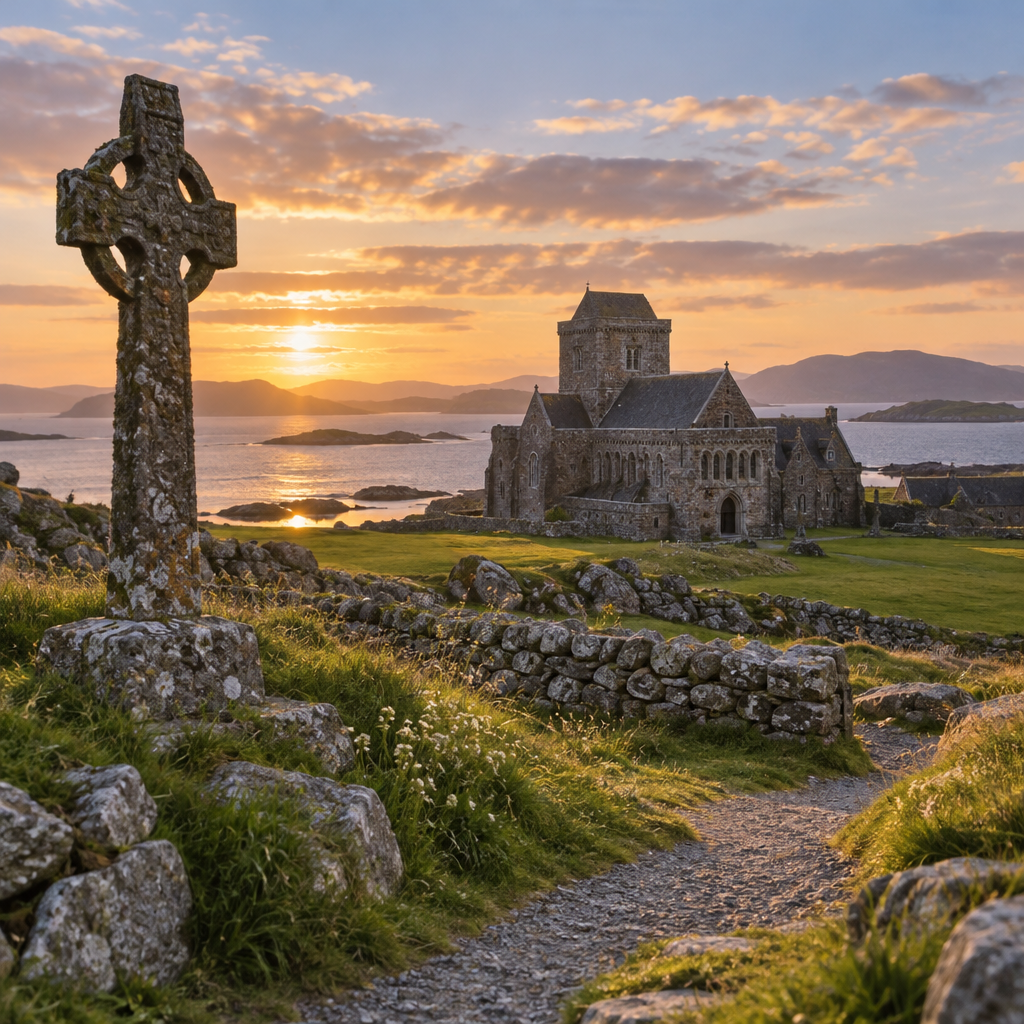
The sea crossing to Iona is short, but it can feel like a threshold. Beyond the Sound of Iona, the abbey rises above a small island of pasture, rock and pale sand. For generations, Christians have come here seeking something quieter than certainty: room to listen, to pray and to begin again.
For a Catholic pilgrim, Iona offers a connection with St Columba and the early Christian life of these islands. It is also a place to encounter Christians of other traditions, with gratitude for our shared inheritance and prayer for unity.
St Columba and the island’s story
Columba, also known as Colum Cille, was an Irish monk who established a monastery on Iona in 563. Tradition holds that twelve companions travelled with him. From this small island, his community became an influential centre of prayer, learning and missionary work, helping to spread Christianity among the Picts and sustaining connections across Ireland and Britain.
Columba died on Iona in 597. Much of what we know about him comes through Adomnán, a later abbot whose account combines memories of the saint with stories of miracles. Such writings reveal the community’s faith, but not every detail can be treated as independently verified history.
Tradition holds that Columba chose Iona because he could no longer see his Irish homeland from its shores. Whether or not that explains his choice, his life invites reflection on leaving familiar comforts to follow God’s call.
The monastery endured Viking attacks from the late eighth century onwards. Its community and treasures became connected with other centres, notably Kells in Ireland. The Book of Kells is often associated with Iona, although where its different stages of production took place remains debated.
Around 1200, a Benedictine abbey was founded on the island, and an Augustinian nunnery was established nearby. The surviving buildings belong principally to this medieval chapter rather than Columba’s original settlement. Religious life declined after the Scottish Reformation, and restoration later gave the abbey renewed life.
What to see at Iona Abbey
Allow unhurried time for the abbey church, cloisters and museum. The carved stones and early Christian crosses bear witness to generations who expressed their faith through patient craftsmanship.
Outside the church, look for St Martin’s Cross, a remarkable surviving early medieval high cross. The museum helps explain the island’s sculpture and preserves important original pieces; some monuments displayed outdoors are replicas.
Near the abbey entrance stands the small building known as St Columba’s Shrine. Associated with the saint’s burial and medieval devotion, it offers a place to reflect on the communion of saints without imagining that every visible stone dates from his lifetime.
The nearby burial ground, Reilig Odhráin, and St Oran’s Chapel deserve a quiet visit. Tradition holds that numerous Scottish kings were buried here, though individual burial claims are not all securely documented. Treat the graveyard as a resting place, not simply a historic attraction.
Beyond the abbey walls
The ruined nunnery lies close to the village. Its remaining walls recall the women whose prayer and work also shaped Iona’s Christian history.
For a wider view, climb Dùn Ì, the island’s highest point, if conditions and your mobility permit. The route can be wet and uneven, but the outlook across surrounding islands encourages a generous sense of stillness.
St Columba’s Bay, towards the island’s southern end, is traditionally associated with his arrival. This is a longer walk over rough, sometimes boggy ground: give it proper time rather than adding it hurriedly to an abbey visit.
You need not reach every landmark. A few minutes beside the water, praying for those you carry in your heart, may become the pilgrimage’s most lasting moment.
Getting there and choosing your season
The usual public-transport route is by ferry from Oban to Craignure on Mull, then by bus across Mull to Fionnphort, followed by the passenger ferry to Iona. Check CalMac sailings and connecting bus timetables before travelling; weather can disrupt crossings, and connections need careful planning.
Visitor vehicles are generally not permitted on Iona without authorisation. If driving across Mull, plan to leave your car at Fionnphort. Check parking arrangements and book any vehicle crossing to Mull ahead where required.
Late spring and early autumn often offer a good balance of daylight and quieter paths. Summer brings longer days but more visitors. Winter can be deeply peaceful, though services and accommodation are more limited and weather disruption more likely. Book accommodation early, especially if staying on the island.
What to bring—and how to pray
Pack waterproofs, warm layers, sturdy footwear, water, food for longer walks and an offline map. Sun protection and midge repellent can also be useful. Carry essential medicines and allow flexibility in your return plans.
Check Historic Environment Scotland for abbey admission and access information. The Iona Community, founded in 1938, sustains an ecumenical presence; consult its current worship arrangements. Do not assume that Catholic Mass will be available on the island.
Bring a small prayer book or rosary, but leave space for silence too. Ask for Columba’s intercession, read a Gospel passage and entrust your next step to Christ. You do not need to arrive with everything resolved.