A Pilgrim’s Guide to Our Lady of Guadalupe in Mexico City
Explore the Guadalupe basilica, St Juan Diego’s story and the tilma, with practical advice for a prayerful pilgrimage in Mexico City.
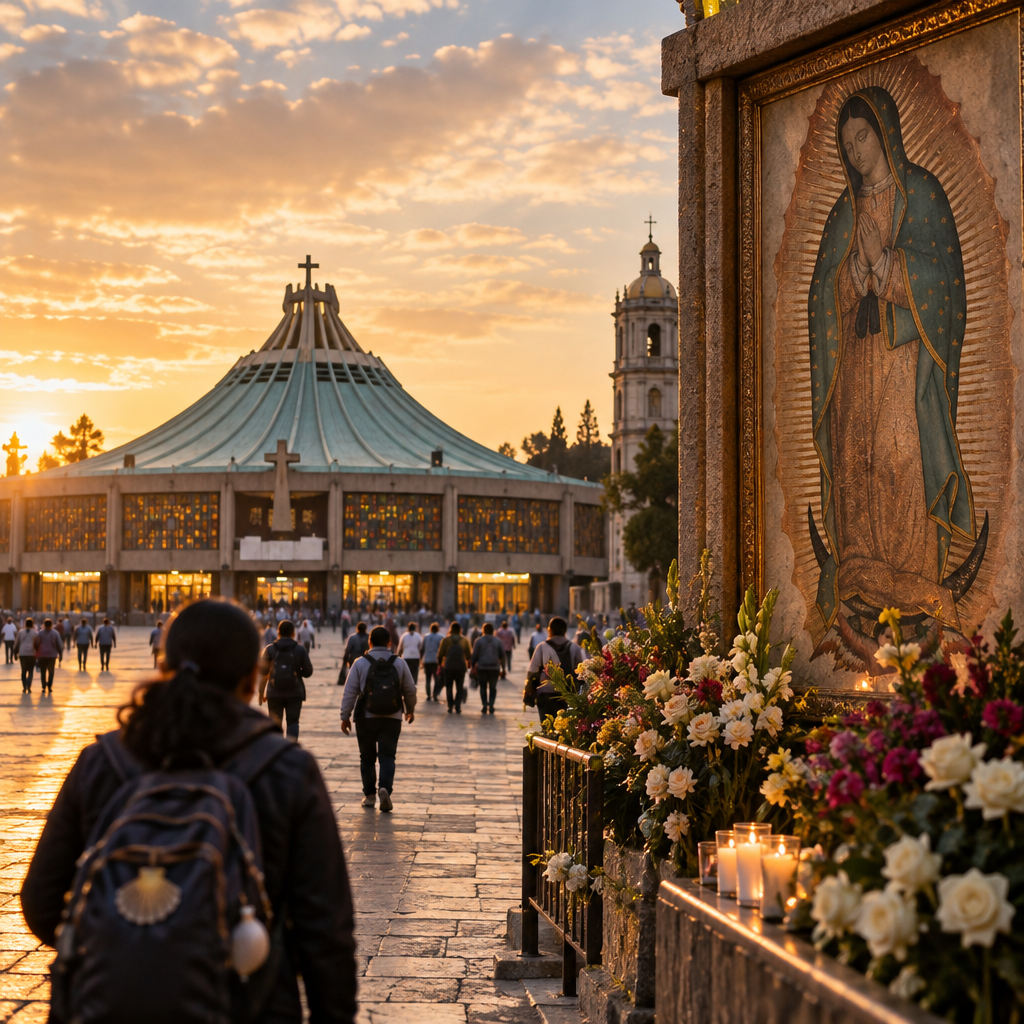
Some journeys begin with a question carried quietly in the heart. At the Shrine of Our Lady of Guadalupe in Mexico City, that question joins the prayers of countless pilgrims who come seeking comfort, healing and a deeper trust in God.
This is a living place of worship, not simply a historic monument. Its centre is an image of Mary on a tilma, a cloak associated with St Juan Diego. Around it, the basilica and the hill of Tepeyac invite visitors to slow down and listen.
St Juan Diego and the story of Guadalupe
According to the Church’s received account, the Virgin Mary appeared to Juan Diego, an Indigenous Christian convert, at Tepeyac in December 1531. She asked that a church be built there, where people could encounter her maternal care and turn towards her Son.
Juan Diego brought the request to Bishop Juan de Zumárraga, who sought a sign. Tradition holds that Mary directed Juan Diego to gather roses from the hill despite the winter season. He carried them in his tilma; when he opened it before the bishop, the flowers fell and an image of Our Lady appeared on the cloth.
The account also tells of the healing of Juan Diego’s uncle, Juan Bernardino. Its enduring spiritual message is one of closeness: those who feel small, overlooked or afraid are not forgotten by God.
The apparitions belong to the Church’s tradition of private revelation; they do not add to the Gospel. Catholic devotion to Our Lady of Guadalupe leads towards Christ, whose mercy Mary helps pilgrims to receive.
Pope St John Paul II canonised Juan Diego in 2002. His witness invites us to offer God our ordinary lives, even when we feel unequal to what he asks.
From Tepeyac to the great basilica
Devotion grew around Tepeyac over the centuries. The building commonly called the Old Basilica opened in 1709. Mexico City’s unstable ground contributed to structural problems, and the increasing numbers of pilgrims also called for a larger church.
The present basilica opened in 1976. Its broad, circular design allows large congregations to gather around the sanctuary, with the image of Our Lady visible above and behind the main altar.
Together, the older churches and the modern basilica tell a story of faith carried across generations. The shrine remains especially important to Mexican Catholic identity, while welcoming pilgrims from across the world.
What to see and where to pray
Begin in the main basilica. Before taking photographs or looking for the best view, allow a few minutes simply to sit. If Mass is being celebrated, respect the worshippers and follow stewards’ directions.
The tilma is displayed in a protective enclosure above the sanctuary. A viewing passage with moving walkways beneath the image allows pilgrims a closer look. Follow the current access arrangements, and do not stop or obstruct the walkways. For longer prayer, return to the seating area.
Visit the Old Basilica, also known as the Expiatory Temple of Christ the King, when it is open. Its historic architecture offers a striking contrast with the spacious modern church.
If your mobility and energy allow, climb Tepeyac to the Chapel of the Hill, or Capilla del Cerrito, associated with the apparition story. The ascent offers views across the shrine precinct and space to reflect on Juan Diego’s journey.
The Chapel of the Little Well, or Capilla del Pocito, is another notable stop, valued for its distinctive eighteenth-century architecture. Rather than trying to see everything, leave room for silence.
Getting there and choosing your time
The shrine stands in the Gustavo A. Madero borough in northern Mexico City. La Villa–Basílica station on Metro Line 6 is within walking distance; follow signs towards the shrine. Check current transport information before travelling, particularly during major celebrations.
An authorised taxi or reputable app-booked car can be simpler if you are unfamiliar with the city. Arrange a clear pick-up point outside the busiest pedestrian areas.
For a quieter visit, aim for a weekday morning outside major feast periods. Around 12 December, the feast of Our Lady of Guadalupe, enormous crowds gather: deeply moving for many pilgrims, but demanding in terms of transport, accommodation and stamina.
November to April is generally drier. Rain is more common during the warmer months, often later in the day. Check the forecast and the shrine’s current opening and service information.
What to bring
Wear comfortable shoes and clothing suitable for worship. Bring drinking water, sun protection, a light layer and, during the rainy season, a waterproof jacket. Mexico City’s altitude can make walking more tiring than expected, so pace yourself.
Keep valuables secure and carry only what you need. If steps or long walks are difficult, prioritise the main basilica and ask staff about accessible routes.
A rosary or small notebook may help you pray, but neither is essential. Bring your gratitude, your uncertainty and the names of those you love. There is no need to arrive with perfect words.