Why the Creed Matters: The Council That Defended Christ’s Divinity
Discover how the Council of Nicaea defended Christ’s divinity—and why its words still shape Christian worship and hope.
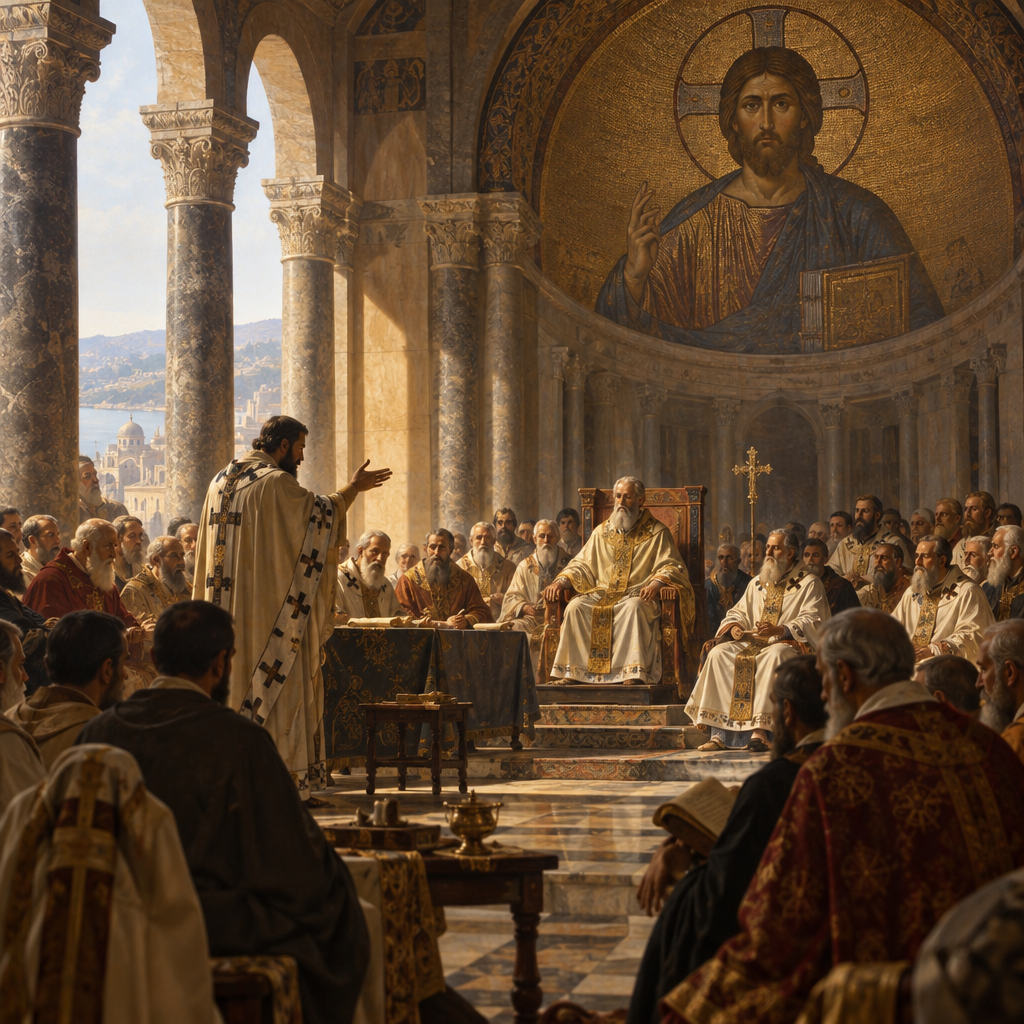
A few words spoken at Sunday Mass carry the weight of a remarkable struggle: “begotten, not made, consubstantial with the Father”. They may sound unfamiliar outside church, yet they answer a deeply personal question: who is Jesus Christ?
Nearly seventeen centuries ago, that question brought bishops together in the city of Nicaea. Their answer still helps Christians understand whom we worship, why we trust him, and what it means to say that God has come near.
A Church emerging from persecution
In AD 325, the Roman Emperor Constantine summoned a council at Nicaea, in what is now İznik, Türkiye. Christianity had only recently gained legal toleration within the empire after periods of severe persecution. Some bishops gathering there had themselves suffered for their faith.
The Church now faced a different danger: a dispute about the identity of the Son of God.
Arius, a priest in Alexandria, taught that the Son had been brought into existence by the Father. In his understanding, the Son stood above all other creatures, but was not eternal God in the same sense as the Father.
This was not merely an argument over technical language. It touched the heart of Christian prayer and salvation. When Christians worshipped Jesus, were they worshipping God—or a creature, however exalted?
The word that drew a clear line
The bishops at Nicaea rejected Arius’s teaching. They confessed that the Son is begotten of the Father, not made, and is of the same divine being as the Father.
The crucial Greek word was homoousios, commonly rendered in English as “consubstantial” or “of one substance”.
That language does not mean that the Father and Son are the same Person. Catholic teaching distinguishes the Father, the Son and the Holy Spirit while confessing one God. The Son is not a lesser deity or the highest item in creation. He is truly God.
“Begotten, not made” also distinguishes the Son’s eternal relationship with the Father from God’s act of creating the world. There was never a time when the Son did not exist.
For Christian faith, this matters profoundly: in Jesus, God has not sent only a messenger. The eternal Son has truly entered our human life to save us.
Did an emperor invent Christian belief?
Constantine wanted religious unity within his empire, and his involvement gave the council an unmistakable political setting. It would be misleading to pretend that imperial power played no part.
But it would be equally misleading to say that Constantine invented belief in Christ’s divinity.
Long before Nicaea, Christians worshipped Jesus and read the Scriptures as bearing witness to his divine identity. The opening of John’s Gospel, for example, speaks of the Word’s eternal existence with God and his becoming flesh (John 1:1–14).
The council’s task was to defend and clarify the faith the Church had received, using language precise enough to exclude an interpretation that undermined it.
Nor did Nicaea choose the books of the Bible. That popular claim confuses separate strands of early Church history.
The Creed took time to reach its familiar form
Nicaea did not end the controversy overnight. Decades of argument, exile and shifting imperial support followed.
Athanasius, who attended the council as a young deacon accompanying his bishop, later became Bishop of Alexandria and one of the most steadfast defenders of Nicene faith.
The Creed commonly recited at Mass today is not simply the council’s original text reproduced unchanged. Its fuller form is associated with the Council of Constantinople in 381, particularly its expanded confession of faith in the Holy Spirit. Its later history includes further differences between Eastern and Western Christian usage.
Behind the familiar Sunday words lies a long, sometimes painful effort to speak faithfully about the mystery of God.
More than an ancient argument
As Catholics gather for Mass this Sunday, 25 October 2026, the Creed connects ordinary parish worship with that early struggle for clarity.
We need not understand every theological term before we can pray it sincerely. Yet learning what the words mean can deepen our trust.
The one who shared our weariness, suffered on the Cross and rose from death is not distant from God’s own life. He is the eternal Son, who became truly human without ceasing to be truly divine.
Let the Creed become more than familiar words: a quiet act of trust in the God who has come to save us.