The Camino Portugués from Porto: A Pilgrim’s Guide to the Central and Coastal Routes
Discover the Camino Portugués from Porto: central and coastal routes, sacred places, practical advice and space for prayer.
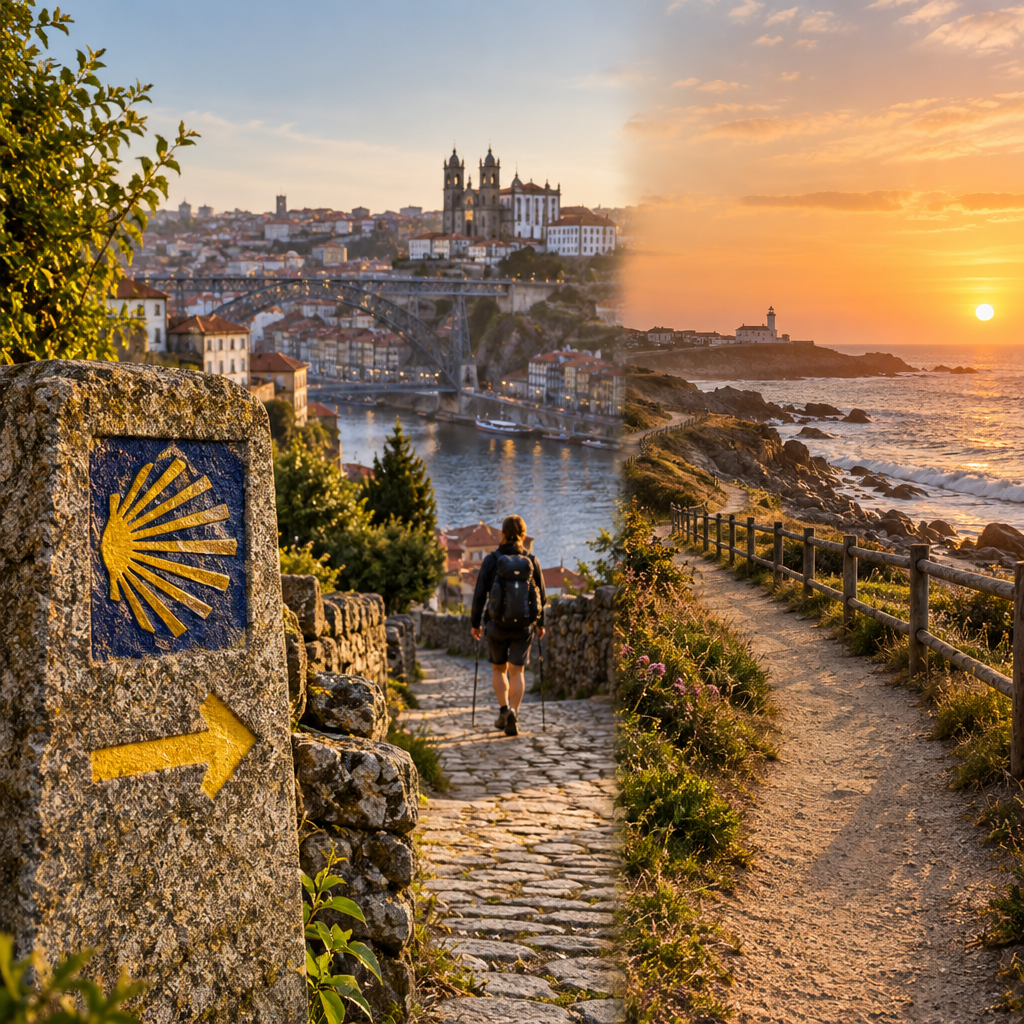
Two paths towards the same hope
Leaving Porto on the Camino Portugués, you join generations of pilgrims travelling towards Santiago de Compostela and the shrine of St James the Apostle. Some carry a clear intention; others bring grief, gratitude or questions they cannot yet put into words.
From Porto, two much-loved paths lead north: the Central Route, through historic towns and inland countryside, and the Coastal Route, where Atlantic shores accompany much of the journey. Both offer beauty, challenge and opportunities to encounter God in ordinary kindness.
You need not arrive with perfect faith. A pilgrimage can begin simply with the willingness to take the next step.
A road shaped by centuries of faith
Pilgrimage to Santiago grew after the ninth-century discovery in Galicia of a tomb believed to be that of St James. Tradition holds that the Apostle’s remains were brought to this part of Spain after his martyrdom.
Routes through Portugal developed over the following centuries, supported by churches, religious communities, bridges and places of hospitality. The Portuguese royal saint Elizabeth of Portugal was among the medieval pilgrims who travelled to Santiago.
Today’s marked paths follow this broader inheritance, though individual sections have changed with roads, development and renewed interest in pilgrimage. Walking them is not a retreat from life so much as a different way of attending to it.
The Central Route: towns, vineyards and woodland
The Central Route from Porto is roughly 240–260 kilometres, depending on your starting point and variants. Many pilgrims allow 10–14 walking days, with additional time for rest.
Its principal stopping places include Vilarinho, Barcelos, Ponte de Lima, Rubiães, Valença, Tui, Redondela, Pontevedra, Caldas de Reis and Padrón before Santiago.
Highlights include:
- Porto Cathedral: a fitting place to begin with prayer, overlooking the city’s old streets.
- Barcelos: a historic riverside town associated with Portugal’s famous cockerel tradition.
- Ponte de Lima: a beautiful town beside the River Lima, with a bridge incorporating Roman and medieval construction.
- Valença and Tui: Portuguese fortifications, a river crossing into Spain and Tui’s cathedral make this a memorable passage.
Expect woodland paths, agricultural landscapes, cobbles and stretches of road. The climb towards Alto da Portela Grande, between Ponte de Lima and Rubiães, is one of the more demanding sections. Shorter stages can make space for both recovery and prayer.
The Coastal Route: sea air and open horizons
The Coastal Route is usually around 270–280 kilometres, with variations that can increase the distance. Allow approximately 12–15 walking days rather than treating it as a race.
Common stopping places include Vila do Conde, Póvoa de Varzim, Esposende, Viana do Castelo, Caminha, A Guarda, Baiona and Vigo. The route joins the Central Route at Redondela.
The names can be confusing: the Senda Litoral generally stays closer to the shore, while the marked Coastal Route sometimes turns inland. Pilgrims often combine the two, particularly when leaving Porto beside the Douro and then following the Atlantic north.
Look out for Vila do Conde’s waterfront and religious heritage, Viana do Castelo’s historic centre and Baiona’s harbour. The Sanctuary of Santa Luzia above Viana offers an optional detour, with a substantial climb or alternative transport.
At Caminha, the crossing of the River Minho towards A Guarda requires planning. Boat availability depends on the operator, weather and tides; check locally rather than assuming a crossing will run. An inland alternative through Vila Nova de Cerveira adds distance.
Getting there and choosing your season
Porto’s airport has Metro connections into the city. Spend a night in Porto if possible: it gives you time to rest, obtain a pilgrim credential and check your first stage.
May, June, September and early October often offer a useful balance of daylight and walking temperatures, although no season guarantees settled weather. Summer can be hot and busy; winter brings shorter days, wetter conditions and fewer open pilgrim services. Coastal wind and rain can be strong throughout the year.
Book key nights ahead in busy periods, especially if you need private accommodation. Municipal pilgrim hostels commonly operate without reservations, but policies vary. Check current accommodation, route diversions and transport before departure.
What to carry — and what to leave behind
Bring broken-in walking shoes, suitable socks, blister care, waterproofs, sun protection, a refillable water bottle, essential medicines and a small first-aid kit. Pack lightly; a heavy rucksack can quickly turn manageable kilometres into painful ones.
Carry your pilgrim credential, collecting stamps along the way. If you hope to receive the Compostela, consult Santiago’s Pilgrim’s Office for current requirements. Walking the final 100 kilometres and collecting at least two stamps daily on that section is the usual approach for eligible walking pilgrims.
Download offline maps, carry some cash and remember that Spain is one hour ahead of Portugal.
Above all, leave room in the day for silence. Enter an open church, attend Mass when possible, or offer a simple prayer for someone you love. Whether your path runs beside vineyards or the sea, Christ can meet you in the next ordinary step.